
Overview
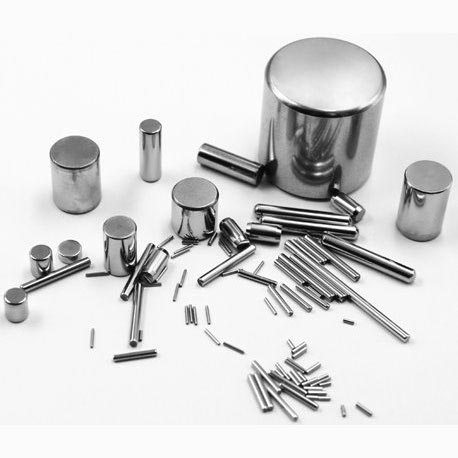
Needle Rollers and Cylindrical Rollers
Needle rollers and cylindrical rollers are the rolling elements inside roller bearings — they carry the load between inner and outer rings. Needle rollers (NRA, NRB) have a small diameter and high length-to-diameter ratio (L/D > 3), making them ideal for compact installations with limited radial space. Cylindrical rollers (ZB, TR, TP) have a larger diameter and higher load capacity for heavy-duty industrial applications. Nibora Ltd. supplies precision needle and cylindrical rollers in 5 types and 6 materials.
NRA and NRB needle rollers (Ø 1–10 mm) are used in needle bearings for universal joints, rocker arm pivots, hydraulic motors and pumps, and transmissions — wherever radial space is limited. ZB, TR and TP cylindrical rollers (Ø 2–50 mm, L up to 100 mm) are used in cylindrical roller bearings for gearboxes, machine tool spindles, railway axle boxes, and heavy industrial machinery. All types are available in chrome steel AISI 52100 (standard) or stainless steel grades. Contact Nibora Ltd. for pricing and availability.
Precision grades G2, G3 and G5 guarantee the geometric accuracy of needle rollers and cylindrical rollers. G2 (roundness < 1 μm) is for ultra-precision applications; G3 (< 1.5 μm) for standard precision bearings; G5 (< 2.5 μm) for general industrial use. Diameter tolerance is 0/–6 μm for needles (NRA/NRB) and 0/–10 μm for rollers (ZB/TR). Contact Nibora Ltd. for current pricing and availability.
Types and tolerances
Needle Roller and Cylindrical Roller Types
| Type | Description | Ø min (mm) | Ø max (mm) | L min | L max | Ø tolerance | Application |
|---|---|---|---|---|---|---|---|
| NRA | Needle, round ends | 1.5 | 8 | 2 mm | 30 mm | 0/–6 μm | Needle bearings, round ends contact the flange |
| NRB | Needle, flat ends | 1.0 | 10 | 2 mm | 30 mm | 0/–6 μm | Needle bearings — most widely used type |
| ZB | Roller, logarithmic profile | 2.0 | 50 | 3 mm | 100 mm | 0/–10 μm | Reduces stress concentration under misalignment |
| TR | Roller, ground ends | 4.0 | 50 | 4 mm | 100 mm | 0/–10 μm | High precision, flat precision-ground ends |
| TP | Roller, flat unground | 4.0 | 50 | 4 mm | 100 mm | 0/–10 μm | Economical version for lower requirements |
Technical Data and Length Tolerances
| Length range | NRA tolerance | NRB tolerance | ZB tolerance | TR tolerance |
|---|---|---|---|---|
| 3–25 mm | 0/–30 μm | 0/–30 μm | 0/–30 μm | 0/–30 μm |
| 25–40 mm | 0/–30 μm | 0/–30 μm | 0/–40 μm | 0/–40 μm |
| 40–100 mm | 0/–30 μm | 0/–30 μm | 0/–60 μm | 0/–60 μm |
Precision Grades G2, G3, G5
| Grade | Roundness | Diameter Tolerance Groups | Surface Ra | Application |
|---|---|---|---|---|
| G2 | < 1 μm | 0/–2 to 0/–8 μm (9 groups) | < 0.10 μm | Ultra-precision bearings, measuring instruments |
| G3 | < 1.5 μm | 0/–3 to 0/–9 μm (6 groups) | < 0.15 μm | Standard precision bearings |
| G5 | < 2.5 μm | 0/–5 to 0/–10 μm (3 groups) | < 0.20 μm | General industrial applications |
Materials and selection
Materials — Chemical Composition and Hardness
| Material | C % | Cr % | Ni % | Mo % | Hardness | Application |
|---|---|---|---|---|---|---|
| AISI 52100 / 100Cr6 | 0.90–1.10 | 1.30–1.60 | – | – | HRC 60–66 | Standard for needle rollers and rollers |
| AISI 304 / W 1.4301 | ≤ 0.07 | 17.00–19.00 | 8.50–10.50 | – | 135–200 HV10 | Food industry, medical, aerosols |
| AISI 316 / W 1.4401 | ≤ 0.07 | 16.50–18.50 | 10.50–13.50 | 2.00–2.50 | 135–200 HV10 | Chemical, marine, pharmaceutical |
| AISI 420C / W 1.4034 | 0.30–0.50 | 12.50–14.50 | – | – | HRC 50–57 | Corrosive environment + hardness |
| AISI 430 / W 1.4016 | ≤ 0.08 | 15.50–17.50 | – | – | 280–380 HV10 | Decorative and mild corrosive conditions |
| AISI 440C / W 1.4125 | 0.95–1.20 | 16.00–18.00 | – | 0.40–0.80 | HRC 58–65 | Max hardness + corrosion resistance |
Selecting Needle Rollers and Rollers by Application
| Application | Recommended type | Recommended material | Note |
|---|---|---|---|
| Universal joints and couplings | NRB | AISI 52100 | Flat ends, compact design |
| Rocker arm pivots | NRA or NRB | AISI 52100 | NRA when ends contact the flange |
| Hydraulic pumps and motors | NRB or TR | AISI 52100 or 440C | TR for higher precision |
| Gearboxes and transmissions | ZB or TR | AISI 52100 | ZB for minor angular misalignment |
| Machine tool spindles | TR — G2 or G3 | AISI 52100 | Maximum precision |
| Food industry | NRB or TR | AISI 316 | Non-magnetic, sterilisation-resistant |
| Corrosive environment | NRB or TR | AISI 440C or 316 | 440C when hardness is also needed |
| Heavy loads | ZB or TR — large Ø | AISI 52100 | ZB logarithmic profile reduces peak load |
Specifications
Download PDF ↓Frequently Asked Questions
What is the difference between needle rollers and cylindrical rollers?
Needle rollers (NRA, NRB) have a small diameter (1–10 mm) and high L/D ratio (>3) — thin and long like needles. Used in compact needle bearings. Cylindrical rollers (ZB, TR, TP) have larger diameters (2–50 mm) and a more balanced L/D ratio — for higher load capacity in cylindrical roller bearings.
What is the difference between NRA and NRB needle rollers?
NRA rollers have round ends — used when the roller ends contact the bearing ring flange. The round end prevents stress concentration at the contact point. NRB rollers have flat ends — for applications where ends do not contact the flange. NRB is the most widely used type.
What is special about ZB logarithmic profile cylindrical rollers?
ZB rollers have a special logarithmic profile — the diameter is slightly larger in the centre and tapers toward the ends following a logarithmic curve. This distributes load evenly across the contact length and prevents edge stress concentration when there is slight angular misalignment between shaft and bearing ring.
Which precision grade — G2, G3 or G5?
G2 (roundness < 1 μm): ultra-precision spindles and measuring machines. G3 (< 1.5 μm): standard precision bearings in machine tools and gearboxes. G5 (< 2.5 μm): general industrial applications. Lower number = higher precision. G3 offers the best price-to-precision ratio for most applications.
What is the price of needle rollers and cylindrical rollers?
Price depends on type (NRA/NRB/ZB/TR), diameter and length, precision grade (G2 is more expensive than G5), and material (chrome steel is less expensive than stainless steel). Contact Nibora Ltd. for current pricing.
Can needle rollers work in corrosive environments?
Standard AISI 52100 rollers will rust in wet or aggressive environments. For corrosive conditions: AISI 440C (HRC 58–65, maximum hardness + corrosion resistance) or AISI 316 (non-magnetic, molybdenum protection against chlorides) for food industry applications.
What diameters do you supply?
Needle rollers NRB: Ø 1.0–10 mm; NRA: Ø 1.5–8 mm. Cylindrical rollers ZB and TR: Ø 2–50 mm, length up to 100 mm. All sizes available on request from Nibora Ltd.