
Universal joints are machine components for motion transmission between two shafts whose axes are arranged at an angle. The margin between the maximum and minimum speed of the driven shaft depends on the angle between the two shafts and increases with the angle.
The use of joints with plain bearings, type S, G/GB, is recommended for low-speed drives (up to 1000 rpm). They can withstand shock loads, reversal of rotation direction, uneven rotation and relatively high torque.
For high-speed drives, relatively low torques or larger angles, the use of joints with needle roller bearings, type H, is recommended. They can support up to 4000 rpm.
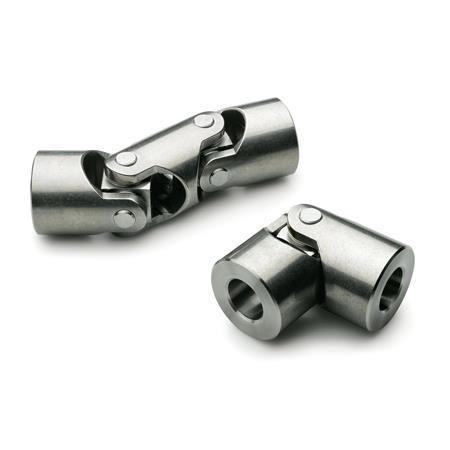 Universal Joints
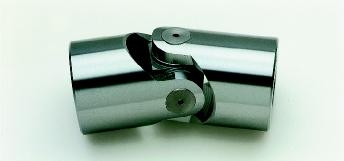
Single Joint "G", DIN 808
Single universal joint per DIN 808, max. bend angle 45°. 13 sizes from 01G (d=6 mm) to 13G (d=50 mm).
| Size | d [H7] (mm) | D (mm) | L2 (mm) | L1 (mm) | C (mm) | Weight (kg) |
|---|---|---|---|---|---|---|
| 01G | 6 | 16 | 34 | 17 | 8 | 0.05 |
| 02G | 10 | 22 | 48 | 24 | 12 | 0.1 |
| 03G | 12 | 25 | 56 | 28 | 13 | 0.16 |
| 04G | 14 | 28 | 60 | 30 | 13 | 0.2 |
| 05G | 16 | 32 | 68 | 34 | 14 | 0.3 |
| 06G | 18 | 36 | 74 | 37 | 17 | 0.45 |
| 07G | 20 | 42 | 82 | 41 | 18 | 0.6 |
| 08G | 22 | 45 | 95 | 47.5 | 22 | 0.95 |
| 09G | 25 | 50 | 108 | 54 | 26 | 1.2 |
| 10G | 30 | 58 | 122 | 61 | 29 | 1.85 |
| 11G | 35 | 70 | 140 | 70 | 35 | 3.15 |
| 12G | 40 | 80 | 160 | 80 | 40 | 4.6 |
| 13G | 50 | 95 | 190 | 95 | 50 | 7.6 |
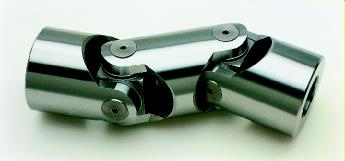
Double Joint "GD", DIN 808
Double universal joint per DIN 808, max. bend angle 90° (double articulation). 13 sizes from 01GD (d=6 mm) to 13GD (d=50 mm), max speed 1000 rpm for all sizes.
| Size | d [H7] (mm) | D (mm) | L2 (mm) | L1 (mm) | C (mm) | L4 (mm) | L3 (mm) | Max speed (rpm) | Weight (kg) |
|---|---|---|---|---|---|---|---|---|---|
| 01GD | 6 | 16 | 34 | 17 | 8 | 22 | 56 | 1000 | 0.08 |
| 02GD | 10 | 22 | 48 | 24 | 12 | 26 | 74 | 1000 | 0.15 |
| 03GD | 12 | 25 | 56 | 28 | 13 | 30 | 86 | 1000 | 0.25 |
| 04GD | 14 | 28 | 60 | 30 | 13 | 36 | 96 | 1000 | 0.4 |
| 05GD | 16 | 32 | 68 | 34 | 14 | 36 | 104 | 1000 | 0.45 |
| 06GD | 18 | 36 | 74 | 37 | 17 | 40 | 114 | 1000 | 0.7 |
| 07GD | 20 | 42 | 82 | 41 | 18 | 46 | 128 | 1000 | 1.0 |
| 08GD | 22 | 45 | 95 | 47.5 | 22 | 50 | 145 | 1000 | 1.55 |
| 09GD | 25 | 50 | 108 | 54 | 26 | 55 | 163 | 1000 | 2.0 |
| 10GD | 30 | 58 | 122 | 61 | 29 | 68 | 190 | 1000 | 2.9 |
| 11GD | 35 | 70 | 140 | 70 | 35 | 72 | 212 | 1000 | 4.75 |
| 12GD | 40 | 80 | 160 | 80 | 40 | 85 | 245 | 1000 | 7.2 |
| 13GD | 50 | 95 | 190 | 95 | 50 | 100 | 290 | 1000 | 12.0 |
full catalogue PDF
Download PDF ↓Frequently asked questions
What is the difference between a single (G) and a double (GD) joint?
The single joint (type G) has one articulation and a max. bend angle of 45°. The double joint (type GD) has two consecutive articulations and a max. angle of up to 90°, compensating the speed variation that occurs in a single joint under angle.
Which transmissions are plain-bearing joints (type S, G/GB) recommended for?
For low-speed transmissions (up to 1000 rpm). They can withstand shock loads, direction reversal, uneven rotation and relatively high torque.
Which transmissions are needle-bearing joints (type H) suited for?
For high-speed transmissions, relatively low torques or large angles — they can support up to 4000 rpm.
What is the allowed bend angle?
Up to 45° for a single joint (type G) and up to 90° for a double joint (type GD).
What is the price of universal joints?
Contact us for a quote — the price depends on type, size and quantity.
Product categories

08:30 – 17:00
37 Balgarska Aviatsia St.