
What are perforated sheets
Perforated sheets are used for making filter components, cleaning drums for sand and stone removal, for producing air conditioning and ventilation ducts, fan housings, screening drums with replaceable elements, and decorative panels in construction and machine design.
They are supplied in sheets sized 1000x2000 mm and 1250x2500 mm, made of mild (low-carbon) or stainless steel, with round, square, slot or special decorative holes.
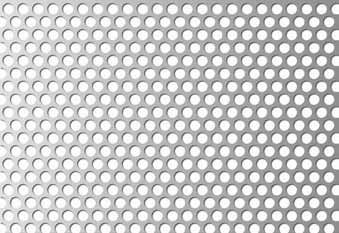
Round holes — mild steel
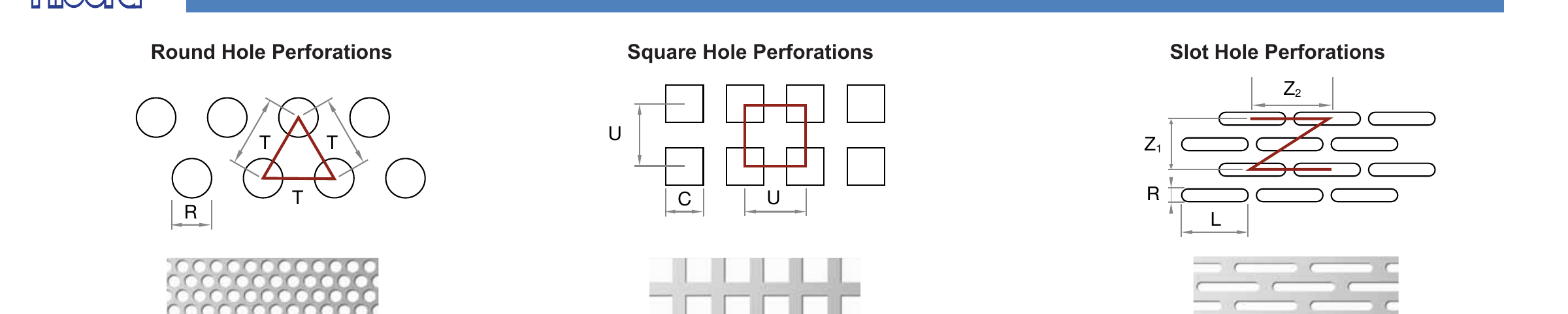
Holes are arranged in a triangular pitch (see diagram) — R is the hole radius, T is the center-to-center distance between adjacent holes.
| Hole R (mm) | Centers (mm) | Open area (%) | Available thicknesses |
|---|---|---|---|
| 0.5 | 1.25 | 14.5 | 0.5 mm |
| 0.6 | 1.25 | 20.9 | 0.5 mm |
| 0.8 | 1.8 | 18.0 | 0.5, 0.8 mm |
| 1.0 | 2.0 | 22.7 | 0.5, 0.8, 1.0 mm |
| 1.25 | 2.5 | 22.7 | 0.5, 0.8, 1.0 mm |
| 1.5 | 2.5 | 32.0 | 0.5, 0.8, 1.0 mm |
| 2.0 | 3.5 | 29.6 | 0.5, 0.8, 1.0, 2.0 mm |
| 2.5 | 4.0 | 35.4 | 0.8, 1.0, 2.0 mm |
| 3.0 | 5.0 | 32.6 | 0.8, 1.0, 2.0, 3.0 mm |
| 3.5 | 5.0 | 36.5 | 1.0, 2.0 mm |
| 4.0 | 6.0 | 29.6 | 1.0, 2.0, 3.0, 4.0 mm |
| 4.5 | 6.0 | 34.9 | 1.0, 2.0 mm |
| 5.0 | 8.0 | 35.4 | 1.0, 2.0, 3.0, 4.0 mm |
| 6.0 | 9.0 | 40.3 | 1.0, 2.0, 3.0, 4.0 mm |
| 7.0 | 10.0 | 44.4 | 1.0, 2.0, 3.0 mm |
| 8.0 | 12.0 | 40.3 | 1.0, 2.0, 3.0, 4.0, 5.0 mm |
| 9.0 | 13.0 | 43.5 | 1.0, 2.0, 3.0 mm |
| 10 | 15.0 | 40.3 | 1.0, 2.0, 3.0, 4.0, 5.0 mm |
| 12 | 18.0 | 40.3 | 1.0, 2.0, 3.0, 4.0, 5.0 mm |
| 15 | 20.0 | 51.0 | 1.0, 2.0, 3.0, 4.0, 5.0 mm |
| 20 | 35.0 | 29.0 | 1.0, 2.0, 3.0, 4.0 mm |
| 25 | 32.0 | 55.0 | 2.0, 3.0, 4.0 mm |
Round holes — stainless steel (AISI)
| Hole R (mm) | Centers (mm) | Open area (%) | Available thicknesses |
|---|---|---|---|
| 0.5 | 1.25 | 14.5 | 0.35, 0.5 mm |
| 0.6 | 1.25 | 20.8 | 0.5 mm |
| 0.8 | 1.8 | 25.7 | 0.5, 0.8 mm |
| 1.0 | 2.0 | 22.7 | 0.8, 1.0 mm |
| 1.25 | 2.5 | 22.7 | 0.8, 1.0 mm |
| 1.5 | 3.0 | 22.7 | 1.0, 1.5 mm |
| 2.0 | 3.5 | 29.6 | 0.8, 1.0, 1.5, 2.0 mm |
| 2.5 | 4.0 | 35.4 | 1.0, 1.5 mm |
| 3.0 | 5.0 | 32.6 | 1.0, 1.5, 2.0 mm |
| 4.0 | 6.0 | 40.3 | 1.0, 1.5, 2.0 mm |
| 5.0 | 8.0 | 35.4 | 1.0, 1.5, 2.0 mm |
| 6.0 | 9.0 | 40.3 | 1.0, 1.5, 2.0 mm |
| 8.0 | 12.0 | 40.3 | 1.0, 1.5, 2.0 mm |
| 10 | 15.0 | 40.3 | 1.0, 1.5, 2.0 mm |
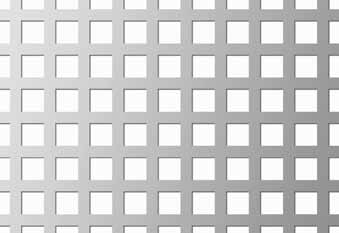
Square holes — mild and stainless steel
C is the side length of the square hole, U is the center-to-center distance between adjacent holes.
| Hole C (mm) | Centers (mm) | Open area (%) | Available thicknesses |
|---|---|---|---|
| 5 | 7.0 | 51.0 | 0.8, 1.0, 1.5 mm |
| 5 | 7.5 | 44.0 | 1.0, 1.5 mm |
| 5 | 8.0 | 39.0 | 1.0, 1.5, 2.0 mm |
| 8 | 10.0 | 64.0 | 0.8, 1.0, 1.5 mm |
| 8 | 12.0 | 44.0 | 1.0, 1.5, 2.0 mm |
| 10 | 12.0 | 70.0 | 1.0, 1.5, 2.0 mm |
| 10 | 12.5 | 64.0 | 1.5 mm |
| 10 | 13.0 | 59.0 | 1.0, 1.5, 2.0 mm |
| 10 | 14.0 | 51.0 | 1.0, 1.5, 2.0 mm |
| 10 | 15.0 | 44.0 | 1.0, 1.5, 2.0 mm |
| 15 | 18.0 | 69.0 | 1.5 mm |
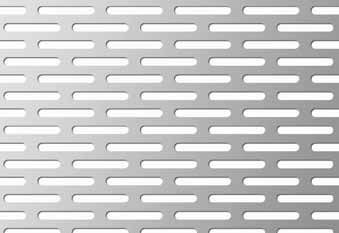
Slot holes — mild and stainless steel
RxL is the slot hole size, Z1xZ2 is the pitch between hole centers.
| Hole R×L (mm) | Centers (mm) | Open area (%) | Available thicknesses |
|---|---|---|---|
| 1.00x20 | 6.32x24 | 26.3 | 1.0 mm |
| 1.25x20 | 7.50x24 | 25.6 | 1.0 mm |
| 1.50x20 | 7.50x24 | 32.7 | 1.0 mm |
| 1.75x20 | 9.20x24 | 31.0 | 1.0 mm |
| 2.00x20 | 8.80x24 | 36.7 | 1.0, 1.5, 2.0 mm |
| 2.25x20 | 10.8x24 | 33.5 | 1.0 mm |
| 2.50x20 | 10.8x24 | 37.5 | 1.0 mm |
| 3.00x20 | 12.0x24 | 40.3 | 1.0, 1.5, 2.0, 3.0 mm |
| 3.50x20 | 14.0x24 | 40.1 | 1.0, 1.5 mm |
| 4.00x20 | 16.0x24 | 39.8 | 1.0, 1.5, 2.0, 3.0 mm |
| 5.00x20 | 17.2x24 | 45.8 | 1.0, 2.0, 3.0 mm |
Specifications
Download PDF ↓Frequently asked questions
Which hole type should I choose?
Round holes are the most universal and provide evenly distributed sheet strength. Square holes give a larger open area for the same hole size. Slot (elongated) holes are used mainly for screening and filtering elongated materials.
What is the difference between mild and stainless steel?
Stainless steel (AISI) is used in food, chemical or humid environments requiring corrosion resistance. Mild steel is a more economical choice for standard industrial applications.
What does "open area" mean?
The open area percentage shows how much of the sheet surface is perforated (free) relative to the total area — a higher percentage means better air/liquid flow through the sheet, but lower mechanical strength.
What is the price of perforated sheets?
Contact Nibora Ltd. for a quote based on the selected hole type, size and thickness.