
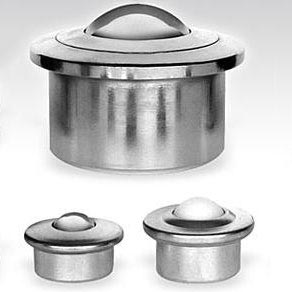
What Is a Ball Transfer Unit?
A ball transfer unit is an omnidirectional load-bearing device consisting of a large precision ball rolling on a bed of small precision balls seated in a hardened hemispheric cup. The large ball rotates freely in all directions, allowing smooth 360° movement of loads across a flat surface with minimal effort. The friction coefficient is only 0.5–3% of the conveyed mass — enabling manual handling of heavy industrial loads. RGP ball transfer units are available in main ball diameters from 8 mm to 90 mm, with load capacities from 3 kg (plastic series) up to 3,000 kg (super heavy duty).
For What Purpose / Who Are They Suitable For?
Ball transfer units are used wherever loads need to be moved freely in multiple directions across a flat surface. Key applications: aircraft cargo rolling decks and airport handling units; sheet metal-working machines and hydraulic presses; ball transfer tables for industrial handling; marble and granite processing; ceramic tile and brick machines; sliding walls and doors; robotics and electronics assembly; automotive stamping racks; and conveyor transfer sections. The SPP plastic series serves food, pharmaceutical and medical applications requiring non-magnetic, electrically insulating components.
What Characterises RGP Ball Transfer Units?
RGP manufactures two main construction types: machined and hardened steel housing (SPM/SBM — for heavy loads, impacts, and harsh conditions) and pressed metal sheet housing (SPS — for lighter loads at lower cost, dimensionally interchangeable with SPM). The plastic series SPP uses acetal resin (POM/Delrin) — non-magnetic, non-conductive, resistant to salt water and chemicals. All steel versions are available in chrome steel (AISI 52100), zinc-plated steel with stainless balls (version C), or fully stainless AISI 420C (version SS). A felt sealing system and self-cleaning drain hole are standard on heavy duty types. Spring-loaded versions compensate for surface unevenness.
Series Overview — RGP Ball Transfer Units
| Series | Construction | Ball Ø (mm) | Max Load (kg) | Key Feature |
|---|---|---|---|---|
| SPM Heavy Duty | Machined hardened steel, flange | 12–45 | 600 / 420 | Felt seal, drain hole, hardened cover |
| SPM Super HD | Case-hardened steel | 60–90 | 3,000 / 2,000 | For extreme loads |
| SPM-R | As SPM + Seeger DIN 471 clip | 15–45 | 600 / 420 | Variable depth mounting |
| SPM CARGO | Airport/depot — no felt seal | 30–45 | 400 | 7 drain holes, sealing coating |
| SPM CX | CARGO + inner AISI 420C ball race | 30–45 | 400 | Higher fluency and durability |
| SBM | Machined steel, no flange | 8–45 | 600 / 420 | Minimal housing overhang |
| SBM FL | Machined steel + threaded stud | 8–15 | 50 / 35 | Screw-in mounting |
| SBM-I | Machined steel + inner thread | 12–45 | 600 / 420 | Bolt-from-below mounting |
| Spring Loaded | External housing + inner spring | 22–45 | 215 | Compensates surface unevenness |
| SPS Light Duty | Pressed metal sheet | 12–45 | 420 / 300 | Interchangeable with SPM, lower cost |
| SPS DV | Pressed sheet + fixing holes | 15–25 | 60 | Screw or rivet mounting |
| SPS SC | Pressed sheet + holes + felt | 22 | 120 / 80 | As DV + felt sealing |
| SPP Plastic | POM acetal resin (Delrin) | 15–45 | 25 / 20 | Non-magnetic, non-conductive |
| SPP 25 | ABS plastic + metal inner race | 25 | 25 | Economical plastic version |
Ball Transfer Units Catalogue
Download PDF ↓FAQ — Ball Transfer Units
What is the difference between SPM and SPS ball transfer units?
SPM (heavy duty) has a housing machined from rod and hardened — for heavy loads, impacts and harsh conditions, up to 600 kg for SPM 45. SPS (light duty) uses pressed metal sheet housing — lighter, lower cost, dimensionally interchangeable with SPM. Recommended for lighter loads (up to 420 kg for SPS 45).
How many ball transfer units are needed for a table or platform?
Rule: distance between units = shortest side of load ÷ 3.5. For a 700×1000 mm sheet: distance = 200 mm (700÷3.5). Individual unit load = total load ÷ 3. Always apply an appropriate safety margin for uneven load distribution.
When should I choose plastic main ball versions (BD/CD)?
Plastic main ball versions are for delicate surfaces — glass, crystal, wood, painted or glazed metal sheets. They will not scratch or mark the surface. Operating temperature 0–60°C. Not suitable for ball-downwards orientation. Load capacity is significantly lower than steel ball versions.
What is the maximum operating temperature?
Standard: –20°C to +70°C continuous, up to +100°C intermittent. Without inner dust cover gasket: up to +150°/200°C. For high-temperature use: fully stainless AISI 420C without felt sealing. Plastic components: 0–60°C only.
What are CARGO and CX ball transfer units designed for?
Both CARGO and CX are designed for airport cargo handling, deposits and intensive-use logistics. CARGO omits the felt seal for maximum fluency, with 7 drain holes and sealing coating for moisture/dust. CX adds an inner hardened AISI 420C stainless steel ball race for longer service life under heavy continuous use.
Can ball transfer units be used in any orientation?
Yes — they can be positioned in any orientation. However, with the main ball facing downwards (non-conventional), reduced load capacity and fluency must be expected. Plastic ball versions and some special types are suitable only with ball facing upwards.
What is the friction coefficient of RGP ball transfer units?
High Capacity (SPM heavy duty, optimal conditions): 0.5% of conveyed mass. Medium Duty: 2%. Light Duty (SPS): 3%. These values apply in optimal conditions with proper surface alignment and adequate lubrication.