
ISO 5296 timing belts (XL, L, H, XH)
ISO 5296 timing belts have a trapezoidal tooth profile in 4 pitches — from XL (5.080 mm pitch) to XH (22.225 mm pitch). Made of neoprene reinforced with glass fiber cords.
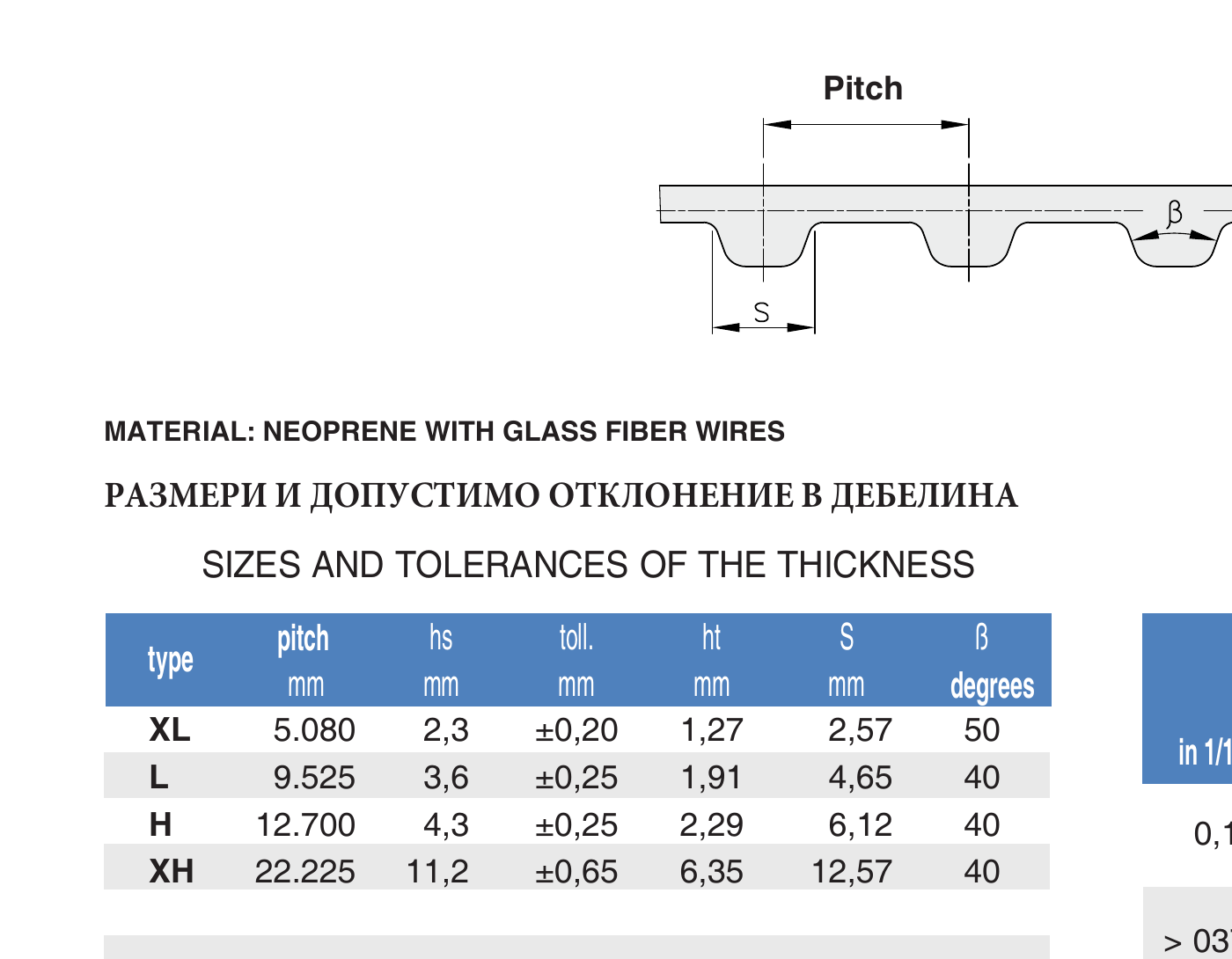
| Type | Pitch (mm) | hs (mm) | Tolerance | ht (mm) | S (mm) | β (°) |
|---|---|---|---|---|---|---|
| XL | 5.080 | 2.3 | ±0.20 | 1.27 | 2.57 | 50 |
| L | 9.525 | 3.6 | ±0.25 | 1.91 | 4.65 | 40 |
| H | 12.700 | 4.3 | ±0.25 | 2.29 | 6.12 | 40 |
| XH | 22.225 | 11.2 | ±0.65 | 6.35 | 12.57 | 40 |
| Available belt width — XL | L | H | XH |
|---|---|---|---|
| XL: 6,35 mm | L: 12,70 mm | H: 19,05 mm | XH: 50,80 mm |
| XL: 7,94 mm | L: 19,05 mm | H: 25,40 mm | XH: 76,20 mm |
| XL: 9,52 mm | L: 25,40 mm | H: 38,10 mm | XH: 101,60 mm |
| H: 50,80 mm | XH: 127,00 mm | ||
| H: 76,20 mm |
HTD timing belts (3M, 5M, 8M, 14M)
The HTD profile has a curvilinear (not trapezoidal) tooth profile for better load distribution and higher transmitted torque at the same width. Made of neoprene reinforced with glass fiber cords, in 4 pitches from 3M (3 mm) to 14M (14 mm).
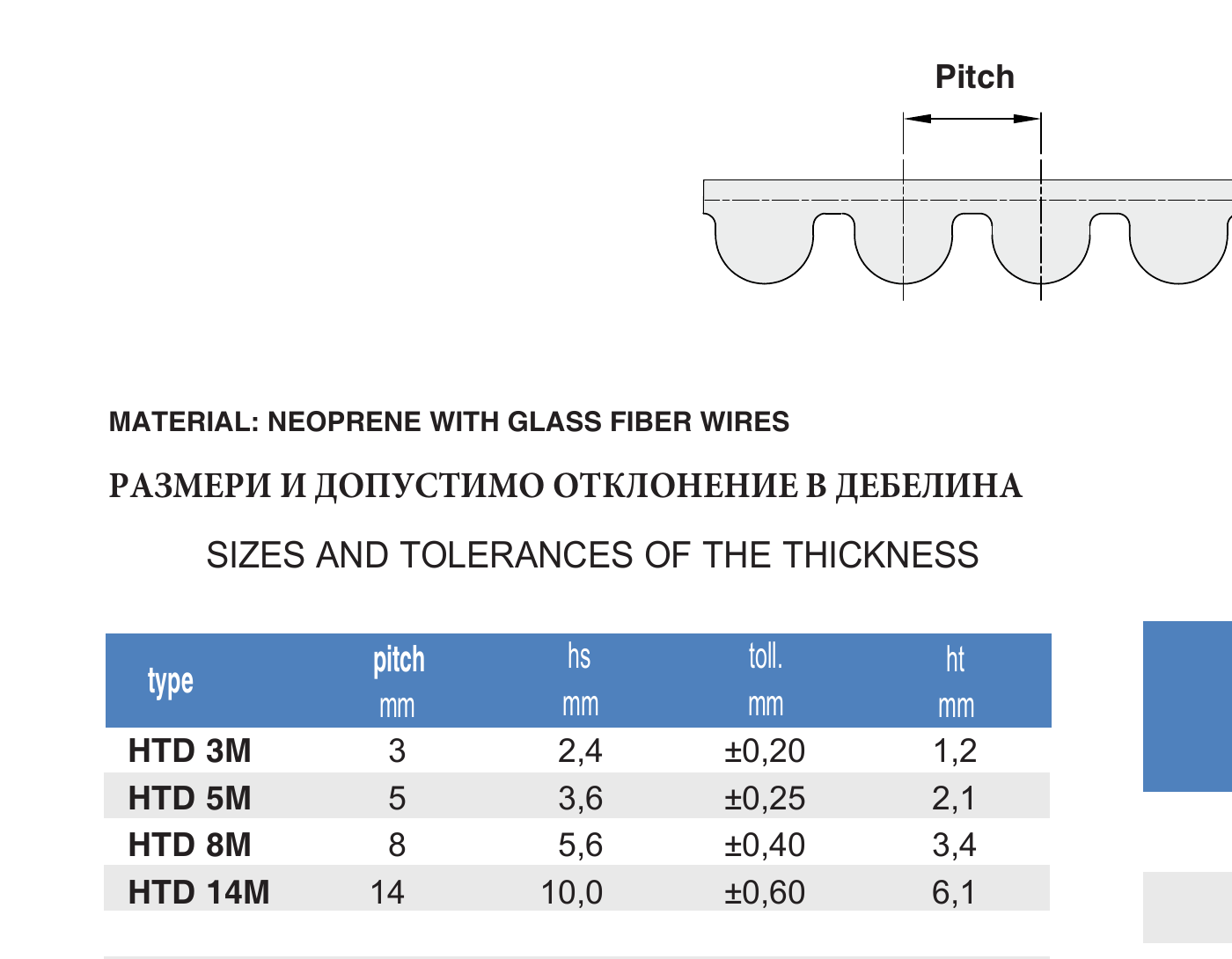
| Type | Pitch (mm) | hs (mm) | Tolerance | ht (mm) |
|---|---|---|---|---|
| HTD 3M | 3 | 2.4 | ±0.20 | 1.2 |
| HTD 5M | 5 | 3.6 | ±0.25 | 2.1 |
| HTD 8M | 8 | 5.6 | ±0.40 | 3.4 |
| HTD 14M | 14 | 10.0 | ±0.60 | 6.1 |
| Available belt width — 3M | 5M | 8M | 14M |
|---|---|---|---|
| 3M: 6 mm | 5M: 9 mm | 8M: 20 mm | 14M: 40 mm |
| 3M: 9 mm | 5M: 15 mm | 8M: 30 mm | 14M: 55 mm |
| 3M: 15 mm | 5M: 25 mm | 8M: 50 mm | 14M: 85 mm |
| 8M: 85 mm | 14M: 115 mm | ||
| 14M: 170 mm |
"T" series timing belts, DIN 7721-1 (T2.5, T5, T10)
The metric "T" profile per DIN 7721-1 is a trapezoidal tooth profile made of polyurethane reinforced with steel cords — higher hardness and wear resistance than neoprene belts. Three pitches: T2.5 (2.5 mm), T5 (5 mm) and T10 (10 mm).
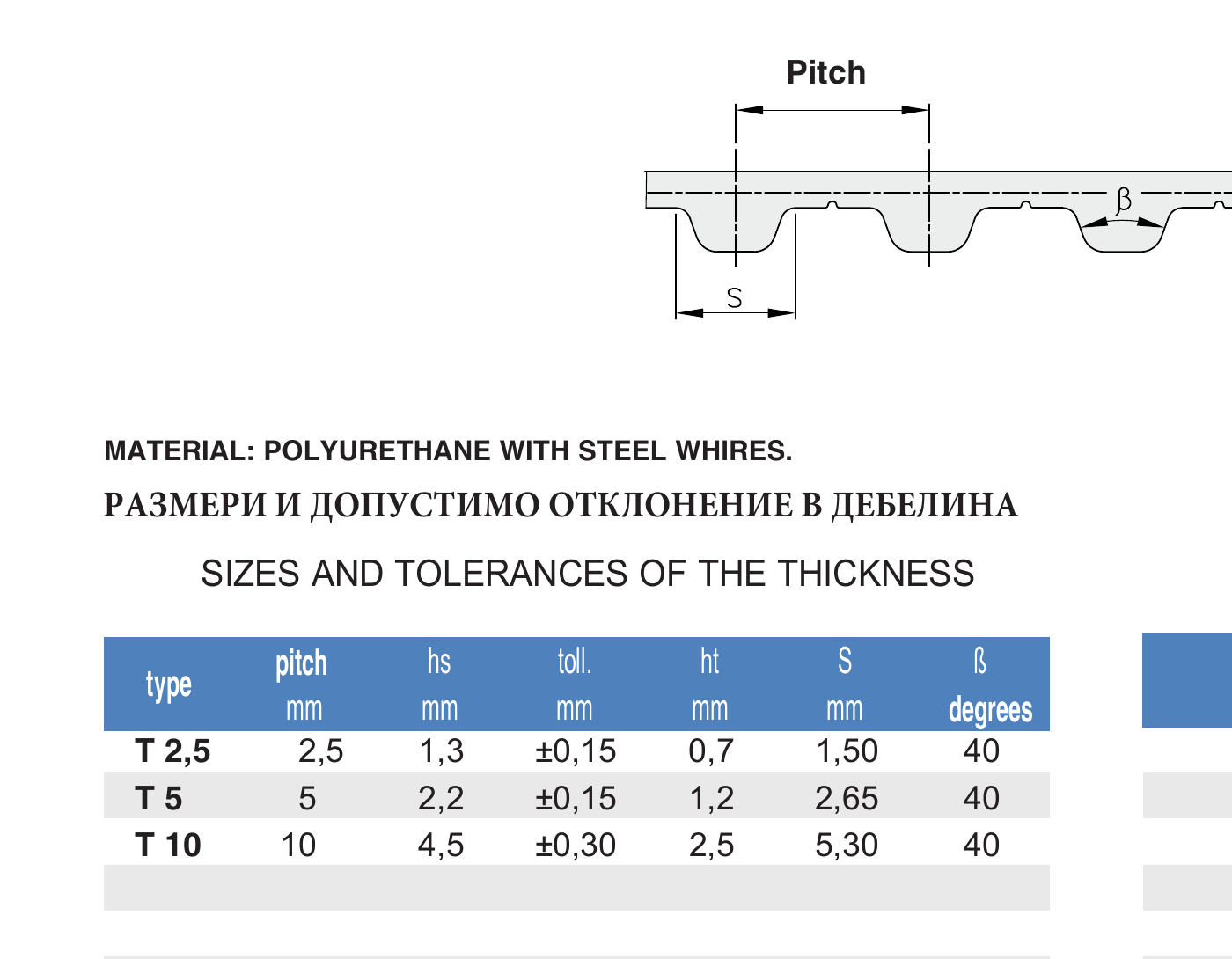
| Type | Pitch (mm) | hs (mm) | Tolerance | ht (mm) | S (mm) | β (°) |
|---|---|---|---|---|---|---|
| T 2.5 | 2.5 | 1.3 | ±0.15 | 0.7 | 1.50 | 40 |
| T 5 | 5 | 2.2 | ±0.15 | 1.2 | 2.65 | 40 |
| T 10 | 10 | 4.5 | ±0.30 | 2.5 | 5.30 | 40 |
| Available belt width — T2.5 | T5 | T10 |
|---|---|---|
| T2.5: 6 mm | T5: 10 mm | T10: 16 mm |
| T5: 16 mm | T10: 25 mm | |
| T5: 25 mm | T10: 32 mm | |
| T10: 50 mm |
"AT" series timing belts (AT5, AT10)
The "AT" profile is an improved metric trapezoidal tooth profile made of polyurethane reinforced with steel cords, in two pitches: AT5 (5 mm) and AT10 (10 mm).
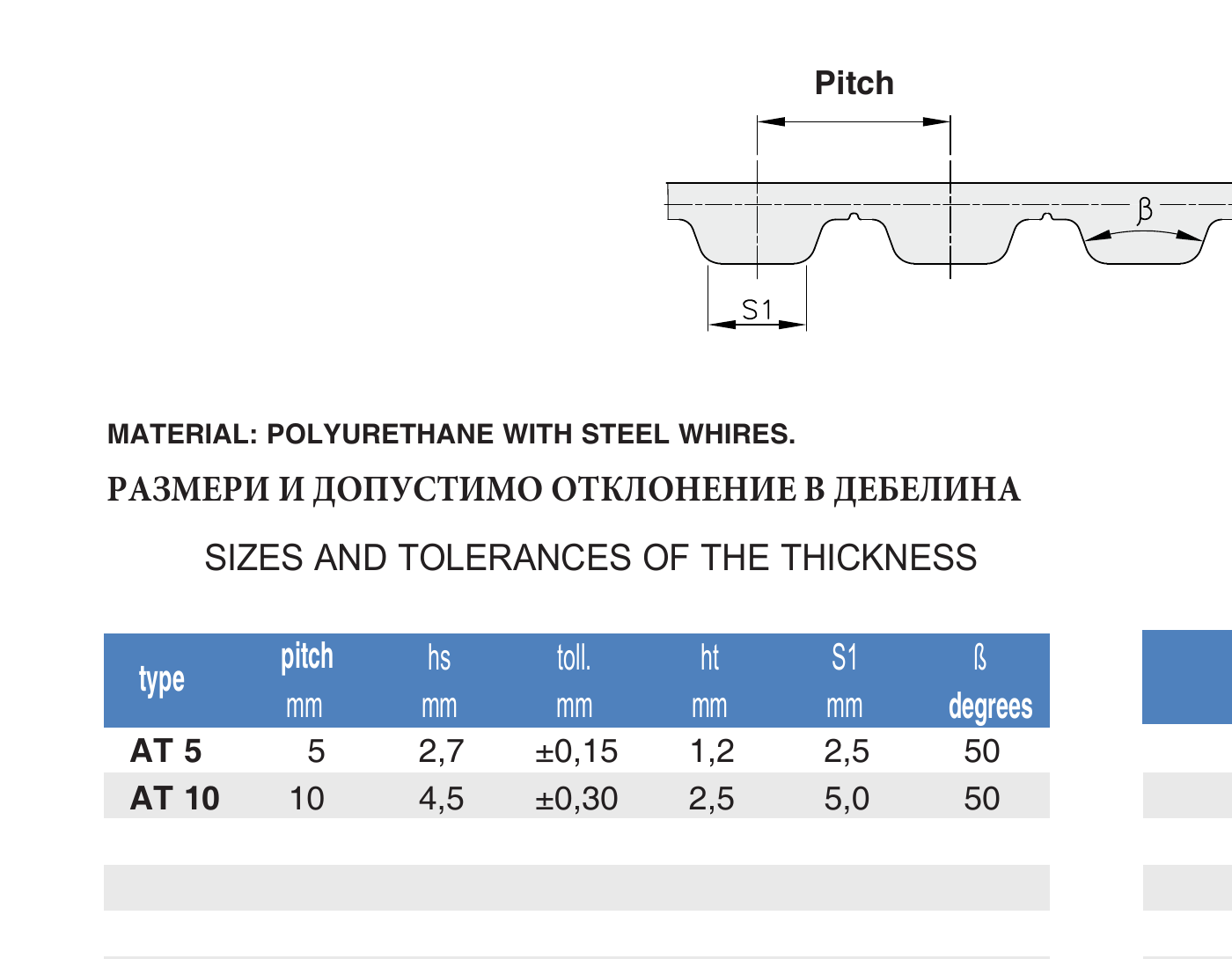
| Type | Pitch (mm) | hs (mm) | Tolerance | ht (mm) | S1 (mm) | β (°) |
|---|---|---|---|---|---|---|
| AT 5 | 5 | 2.7 | ±0.15 | 1.2 | 2.5 | 50 |
| AT 10 | 10 | 4.5 | ±0.30 | 2.5 | 5.0 | 50 |
| Available belt width — AT5 | AT10 |
|---|---|
| AT5: 10 mm | AT10: 16 mm |
| AT5: 16 mm | AT10: 25 mm |
| AT5: 25 mm | AT10: 32 mm |
| AT10: 50 mm |
full catalogue PDF
Download PDF ↓Look up standard lengths by belt standard and profile
| Type | Teeth | Length (mm) |
|---|
No matching size — contact us for a custom configuration.
Frequently asked questions
Are HTD, T and AT profiles interchangeable?
No. HTD, T and AT profiles are NOT interchangeable, even when they share the same metric pitch size (for example HTD 5M and T5 both have a 5 mm pitch) — tooth shape, material and load ratings differ. The belt and pulley must always be the same profile.
What material are the belts made of?
ISO 5296 and HTD belts are made of neoprene reinforced with glass fiber cords. "T" series (DIN 7721-1) and "AT" belts are made of polyurethane reinforced with steel cords.
What standard is each profile made to?
ISO 5296 defines the trapezoidal XL/L/H/XH profiles. The "T" series follows DIN 7721-1. HTD and AT are established metric profiles with a curvilinear/improved tooth used worldwide alongside the listed standards.
How do I choose the right profile, pitch and length?
Choose the profile to match your existing pulley (profiles are not interchangeable), then use the filter below to check available standard lengths for that size. If in doubt, contact us to verify.
What is the price of timing belts?
Contact us for a quote — the price depends on profile, length, width and quantity.