
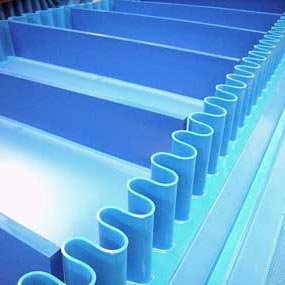
PVC and PU Conveyor Belts with Profiles
Siegling Transilon profiled conveyor belts from Forbo are engineered for inclined conveying of bulk goods and small items. Profiled conveyor belts are available in a wide range of shapes and sizes — PVC, polyurethane (PU), and polyester profiles — ensuring reliable grip at inclinations up to 90°. Nibora Ltd. is the authorised distributor of Forbo Siegling profiled conveyor belts in Bulgaria.
Profiles are attached by welding or hot-bonding and fall into two categories: lateral profiles (K, T, TW, L, F shapes) and longitudinal profiles. Lateral profiled conveyor belts arrest material movement on inclines; longitudinal profiles centre the load across the belt width. Sidewall profiles contain bulk materials along the belt edges, increasing conveying capacity. Sidewall and profile combinations are used in steep-incline and bucket-elevator conveyors.
PVC profiles (60 Shore-A) span K 6 through K 30, plus T, TW, L, and F shapes. PU profiles (65 or 87 Shore-A) offer a wider temperature range (–30°C to +80°C) and better abrasion resistance. Polyester profiles (92 Shore-A) handle temperatures up to +100°C. Numerous PVC and PU profile types carry FDA approval for direct food contact.
Surface patterns — AR (anti-skid), GSTR/STR (textured), LG (longitudinal groove, low-noise), RF, R80 (rhomboid), KN (cross-stud), FG (herringbone), VN (staggered stud) — can replace or complement profiles. Perforated profiled conveyor belts support hole diameters from 4 to 30 mm. Proseal edge-sealing extends service life.
Special Types
Special types: knife edge belts (r ≥ 3 mm) for cooling tunnels with FDA/HACCP design; curved belts (rmin = 250 mm) for 90° turns; antistatic and HC (highly-conductive) belts for ESD; SE/FR flame-retardant belts for airports and distribution centres; NA (non-antistatic) belts for electromagnetic environments; ATEX-compliant processing belts. Contact Nibora for a quotation on profiled conveyor belts to your specification.
Profile Types and Dimensions
| Material | Type | Shape | Dimensions b×h×s (mm) | Shore-A | Temp. °C |
|---|---|---|---|---|---|
| PVC | K 6 | K | 6×4×4 | 60 | –10/+70 |
| PVC | K 10 | K | 10×6×6 | 60 | –10/+70 |
| PVC | K 13 | K | 13×8×7.5 | 60 | –10/+70 |
| PVC | K 15 | K | 15×8×9.5 | 60 | –10/+70 |
| PVC | K 17 | K | 17×11×9.5 | 60 | –10/+70 |
| PVC | K 30 | K | 30×16×18 | 60 | –10/+70 |
| PVC | T 20 | T | 20×20 | 60 | –10/+70 |
| PVC | T 60 | T | 70×60 | 60 | –10/+70 |
| PVC | TW 40 | TW | 30×40 | 60 | –10/+70 |
| PVC | TW 60 | TW | 30×60 | 60 | –10/+70 |
| PVC | TW 80 | TW | 40×80 | 60 | –10/+70 |
| PVC | L 40 | L | 33×40 | 60 | –10/+70 |
| PVC | L 60 | L | 33×60 | 60 | –10/+70 |
| PVC | L 80 | L | 46×80 | 60 | –10/+70 |
| PVC | F 20×3 | F | 20×3 | 60 | –10/+70 |
| PVC | F 30×8 | F | 30×8 | 60 | –10/+70 |
| PU | K 6 | K | 6×4×4 | 65 | –30/+80 |
| PU | K 10 | K | 10×6×6 | 65 | –30/+80 |
| PU | K 13 | K | 13×8×7.5 | 65 | –30/+80 |
| PU | K 15 | K | 15×8×9.5 | 65 | –30/+80 |
| PU | K 17 | K | 17×11×9.5 | 65 | –30/+80 |
| PU | T 20 | T | 12×20 | 87 | –30/+80 |
| PU | T 40 | T | 12×40 | 87 | –30/+80 |
| PU | T 60 | T | 12×60 | 87 | –30/+80 |
| PU | F 15×6 | F | 15×6 | 87 | –30/+80 |
| PU | F 30×8 | F | 30×8 | 87 | –30/+80 |
| PE | K 10 | K | 10×6×6 | 92 | –30/+100 |
| PE | K 13 | K | 13×8×7.5 | 92 | –30/+100 |
| PE | K 17 | K | 17×11×9.5 | 92 | –30/+100 |
| PE | T 10 | T | 12×10 | 92 | –30/+100 |
| PE | LB 20–60 | LB | 12×20–60 | 92 | –30/+100 |
Sidewalls
| Material | Type | Height h (mm) | Width (mm) | Temp. °C | Note |
|---|---|---|---|---|---|
| PU | FW 2×40 | 40 | 46 | –30/+100 | FDA |
| PU | FW 2×60 | 60 | 46 | –30/+100 | FDA |
| PU | FW 2×80 | 80 | 46 | –30/+100 | FDA |
| PVC | FW 3×30 | 30 | 36 | –30/+80 | FDA option |
| PVC | FW 3×60 | 60 | 36 | –30/+80 | FDA option |
| PVC | FW 5×40 | 40 | 52 | –10/+70 | FDA option |
| PVC | FW 5×80 | 80 | 52 | –10/+70 | FDA option |
Surface Patterns — Properties
| Pattern | Name | Drainage | Easy cleaning | Wear resistance | Low noise | Incline | FDA |
|---|---|---|---|---|---|---|---|
| AR | Anti-skid | ○ | – | – | ○ | ● | – |
| GSTR | Coarse textured | – | – | – | ○ | ○ | – |
| STR | Textured | – | – | – | ○ | ○ | – |
| LG | Longitudinal groove | ○ | ● | ● | ● | ● | – |
| RF | Fine rhomboid | – | ● | – | ● | – | ● |
| R80 | Rhomboid | – | ● | ● | – | ● | ● |
| KN | Cross-stud | – | – | ● | ● | ● | ● |
| FG | Herringbone | – | ● | – | ● | – | ● |
| VN | Staggered stud | – | ● | ● | – | ● | ● |
| NP | Inverted pyramid | – | ● | ● | – | ● | ● |
Forbo Siegling Transilon Catalogue
Download PDF ↓FAQ — PVC and PU Profiled Conveyor Belts
What inclination angles can profiled conveyor belts achieve?
Transilon profiled conveyor belts allow inclinations from 20° to 90°, depending on profile type and height. Combined with sidewalls, near-vertical conveying is achievable.
What is the difference between PVC and PU profiles?
PVC profiles (60 Shore-A) operate from –10°C to +70°C. PU profiles (65/87 Shore-A) are more flexible with a wider range (–30°C to +80°C) and better abrasion and chemical resistance.
Can profiled conveyor belts be used in the food industry?
Yes. Many PVC and PU profile types carry FDA approval for contact with unwrapped foodstuffs. Blue and white HACCP designs are available.
How are profiles attached?
PVC and PU profiles are attached by welding or hot-bonding. Longitudinal profiles require positioning tolerance of ±1.5 mm for a₁ up to 500 mm.
What is Proseal edge sealing?
Proseal is a factory-applied edge seal that prevents oil, grease, water, and bacteria from penetrating the belt, extending service life. Available for belt widths 40–1000 mm.
Which splice type is recommended?
For profiled conveyor belts with sidewalls — stepped Z-splice or overlap splice. For swan-neck conveyors, the stepped Z-splice is mandatory due to stiffness at the splice.
What special variants are available?
Knife edge (r ≥ 3 mm), curved (rmin = 250 mm), antistatic, HC (highly-conductive), SE/FR flame-retardant, NA (non-antistatic), and ATEX-compliant belts. Enquire at Nibora Ltd.