
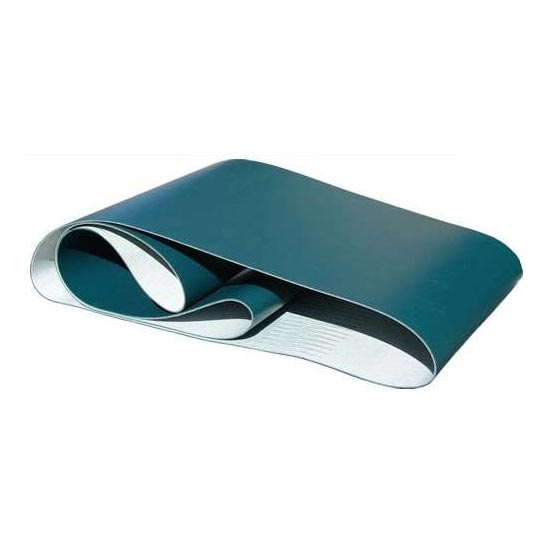
Standard PVC and PU Conveyor Belts — Alexandris AL Series
Alexandris Belting AL-series standard PVC and PU conveyor belts are designed for a wide range of industrial applications. Every AL conveyor belt is antistatic by default and can be delivered as open roll material, endless (vulcanized joint), or with mechanical fasteners. Nibora Ltd. distributes Alexandris conveyor belts throughout Bulgaria on request.
The AL series spans lightweight single-ply PU conveyor belts (AL 40/1 O/U2, 0.7 mm) to heavy-duty three-ply versions (AL 200/3 O/V8-U31, 3.8 mm). PU-surface conveyor belts carry FDA approval; PVC types are available in smooth, inverted-pyramid (NP), and supergrip anti-skid (AR) textures. The AL 160/2 O/V65-L20H with 8.5 mm integral cleats supports steep-incline conveying without separate profiled belts.
The SD value (N/mm) is the key stiffness parameter: it expresses the tension force required to elongate the conveyor belt by 1% of its working length. A higher SD means a stiffer, lower-stretch belt — important for long-centre-distance or heavily loaded conveyor systems. The dmin parameter (minimum drum diameter) is critical for conveyor design.
PU conveyor belts operate from –30°C to +90°C; PVC types from –10°C to +70°C. PU-surface belts (AL 40/1, 60/2) carry FDA approval; white-coated PVC variants can also be FDA-approved. All AL types are antistatic by default per DIN-EN-ISO 284.
Alexandris conveyor belts are used in the food, pharmaceutical, cosmetics, light manufacturing, packaging, and logistics industries — anywhere a lightweight, precise, antistatic conveyor belt is required.
Technical Specifications — AL Series
| Type | Material | Coating mm | Colour | Plies | FDA | Thickness mm | SD N/mm | Temp. °C | dmin |
|---|---|---|---|---|---|---|---|---|---|
| AL 40/1 O/U2 | PU | 0.2 smooth | white | 1 | ● | 0.7 | 4 | –30/+90 | r3–8 |
| AL 60/2 O/U2 | PU | 0.2 smooth | white | 2 | ● | 1.1 | 6 | –30/+90 | r3–8 |
| AL 60/2 O/U2 NP | PU | 0.2 NP | white | 2 | ● | 1.2 | 6 | –30/+90 | r3–8 |
| AL 80/2 O/U/O | PU | impregnated | natural | 2 | ● | 1.2 | 8 | –30/+90 | 20 |
| AL 80/2 O/V5-U10 | PVC | 0.5 smooth | green | 2 | – | 2.0 | 8 | –10/+70 | 50 |
| AL 80/2 O/V5-F10 | PVC | 0.5 smooth | white | 2 | ● | 2.0 | 8 | –10/+70 | 50 |
| AL 80/2 O/V5-NP | PVC | 0.5 NP | white | 2 | ● | 2.1 | 8 | –10/+70 | 50 |
| AL 80/2 O/V20 | PVC | 2.0 smooth | green | 2 | – | 3.2 | 8 | –10/+70 | 60 |
| AL 80/2 O/V20 (white) | PVC | 2.0 smooth | white | 2 | ● | 3.2 | 8 | –10/+70 | 60 |
| AL 80/2 O/V20 AR | PVC | 2.0 AR | green | 2 | – | 5.0 | 8 | –10/+70 | 60 |
| AL 160/2 O/V65-L20H | PVC | 6.5 sg. | green | 2 | – | 8.5 | 16 | –10/+70 | 120 |
| AL 200/3 O/V8-U31 | PVC | 0.8 smooth | green | 2 | – | 3.8 | 20 | –10/+70 | 140 |
| AL 80/2 O/U/O-R19 | fabric | textured | white | 2 | ● | 2.4 | 8 | –10/+90 | 50 |
Alexandris Belting Catalogue
Download PDF ↓FAQ — Alexandris Standard PVC and PU Conveyor Belts
What is the difference between PU and PVC conveyor belts in the AL series?
PU conveyor belts (AL 40/1, 60/2) work down to –30°C, carry FDA approval, and are ideal for food industry. PVC conveyor belts (AL 80/2+) have thicker coatings and higher stiffness for heavier loads.
What does the SD value mean?
The SD value (N/mm) is the tensile force required to elongate the conveyor belt by 1% of its operating length. A key parameter for sizing conveyor drives and take-up systems.
Can AL conveyor belts be supplied endless?
Yes — as open roll, endless with vulcanized joint, or with mechanical fasteners. Minimum dimensions depend on the specific conveyor belt type.
What surface textures are available?
Smooth, inverted pyramid (NP), and anti-skid supergrip (AR). The AL 80/2 O/V20 AR enables inclined conveying without separate profiled conveyor belts.
What industries use AL conveyor belts?
Food, pharmaceutical, cosmetics, packaging, and light logistics — anywhere a lightweight, antistatic conveyor belt with FDA option is required.
What is the minimum drum diameter?
AL 40/1 O/U2: dmin = r3–8 mm (knife edge). AL 80/2 O/V20: dmin = 60 mm. AL 160/2 O/V65-L20H: dmin = 120 mm.
How are AL belts joined?
Vulcanized splicing is recommended. The belts can also be supplied endless (factory vulcanized) or with mechanical fasteners for on-site installation.