
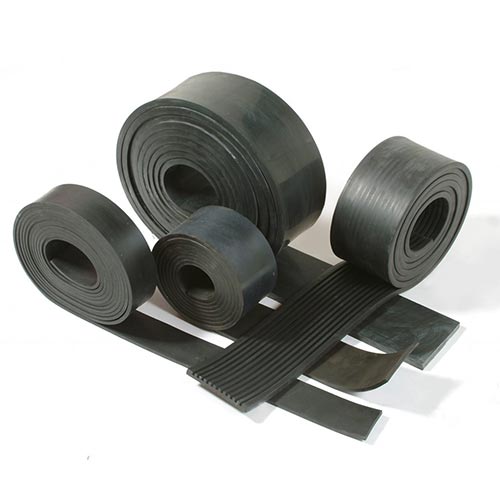
MEC CONV BELTS Rubber Conveyor Belts — Standard and Extra Series
Gummilabor MEC CONV BELTS rubber conveyor belts are engineered for heavy industrial conditions — mining, cement production, steelmaking, chemicals, and recycling. These rubber conveyor belts are produced with 2 to 5 polyester-polyamide (EP) plies, delivering working loads from 16 to 52 kg/cm width. ISO 9001 certified. Nibora Ltd. supplies Gummilabor rubber conveyor belts on request.
The Standard series covers: Normalgum (abrasion-resistant, –35°C to +80°C) for limestone, cement, coke, and aggregates; Oilgum (oil-resistant) for oil seeds and petroleum coke; Temperoilgum (heat + oil resistant to 110°C); Tempergum for hot materials to 110°C (peaks 130°C); Ardentgum for chemically aggressive hot materials to 130°C (peaks 150°C); Superardentgum for extreme heat to 150°C (peaks 200°C). Gummiflat provides low-friction rubber conveyor belts for sliding-bed conveyors.
Special rubber conveyor belt types include: Chevrongum (V-profiles, 20°–40° inclines), Apegum (honeycomb, warehouse handling), CNT (uncoated flat belts), Elevgum (bucket elevators), Endlessgum/E/G/T (jointless rings to 24 m for weighing and dosing), and Pipegum (tube belts, 200–500 mm diameter, up to 565 m³/h at 1 m/s).
Extra EP and Extra D Series — for Heavy Loads
The Extra EP series handles working loads of 63–200 daN/cm with 4–5 EP plies. Extra D aramidic (Kevlar) mono-ply rubber conveyor belts cover 80–250 daN/cm at only 0.3% elongation — a lower-weight replacement for steel-cord rubber belts.
Technical Specifications — Standard Series
| Series | Plies | Cover mm | Belt thickness mm | Working load kg/cm | Temp. °C | Application |
|---|---|---|---|---|---|---|
| Normalgum | 2–4 | 2+1 to 5+2 | 4.5–10.5 | 16–52 | –35/+80 | Limestone, cement, coke, aggregates |
| Oilgum | 2–4 | 4+2 to 5+2 | 7.4–10.5 | 25–52 | –35/+80 | Oil seeds, petroleum coke |
| Temperoilgum | 2–4 | 3+2 to 5+2 | 6.5–10.5 | 20–52 | +110/+130 | Hot and oily materials |
| Tempergum | 2–4 | 3+2 to 5+2 | 6.2–10.5 | 20–52 | +110 (+130) | Coke, sinter, lime, slag |
| Ardentgum | 2–4 | 4+2 to 5+2 | 7.5–10.7 | 25–52 | +130 (+150) | Sulphur, superphosphates, roasted minerals |
| Superardentgum | 2–4 | 4+2 to 5+2 | 7.5–10.7 | 25–52 | +150 (+200) | Fine hot/acidic materials |
| Gummiflat | 2–3 | 2+0 to 3+0 | 3.8–5.7 | 20–40 | –20/+80 | Sliding-bed conveyors |
| Elevgum | 3–5 | 2+4 to 2+5 | 8.3–10.6 | 32–65 | standard | Bucket elevators |
| Chevrongum | 2–4 | 3+2 to 4+2 | 6.2–9.5 | 20–52 | standard | 20°–40° inclines |
| Apegum | 2–3 | 3+0 | 5.4–6.4 | 20–32 | standard | Warehouse, packaging, sorting |
| Endlessgum/E | 2–3 | 3+1 to 4+2 | 7.5–9.0 | 25–54 | –20/+80 | Dosing, weighing, deferrization |
Technical Specifications — Extra EP and Extra D Series
| Series | Class daN/cm | Plies | Cover mm | Thickness mm | Weight kg/m² | Elongation % | dmin mm |
|---|---|---|---|---|---|---|---|
| Extra EP | 630 | 4 | 5+2 | 10.9 | 13.0 | 1.3 | 500 |
| Extra EP | 800 | 4 | 5+2 | 11.5 | 13.8 | 1.3 | 630 |
| Extra EP | 1000 | 4–5 | 5+2 | 12.5–12.7 | 15.0–15.2 | 1.3 | 800 |
| Extra EP | 1250 | 5 | 6+3 | 14.0 | 16.8 | 1.2 | 1000 |
| Extra EP | 1600 | 5 | 6+3 | 16.5 | 19.8 | 1.2 | 1250 |
| Extra EP | 2000 | 5 | 6+3 | 19.0 | 22.8 | 1.2 | 1500 |
| Extra D | 800 | 1 | 5+2 | 8.4 | 8.6 | 0.3 | 500 |
| Extra D | 1000 | 1 | 5+2 | 9.0 | 8.9 | 0.3 | 630 |
| Extra D | 1250 | 1 | 5+2 | 10.6 | 10.2 | 0.3 | 800 |
| Extra D | 1600 | 1 | 6+3 | 13.0 | 12.9 | 0.3 | 1000 |
| Extra D | 2000 | 1 | 6+3 | 14.0 | 13.6 | 0.3 | 1250 |
| Extra D | 2500 | 1 | 6+3 | 15.0 | 14.8 | 0.3 | 1500 |
Standard Dimensions and Norms
Standard rubber conveyor belt widths are 300, 400, 450, 500, 600, 650, 700, 800, 1000, 1200, 1400, and 1600 mm, with wider belts on request. Standard length up to 200 m; supplied as open roll or hot-vulcanized joint. Covers comply with DIN 22102, DIN 22103, UNI 8007. Contact Nibora Ltd. for availability and delivery terms.
GUMMILABOR Catalogue
Download PDF ↓FAQ — Gummilabor Rubber Conveyor Belts
What is the difference between Normalgum and Ardentgum?
Normalgum is the standard abrasion-resistant rubber conveyor belt for materials up to +80°C. Ardentgum handles chemically aggressive hot materials to 130°C (peaks 150°C) — sulphur, superphosphates, roasted minerals.
For what applications is the Extra D series recommended?
Extra D aramidic mono-ply rubber conveyor belts are designed to replace steel-cord belts in long-centre-distance conveyors requiring minimal elongation (0.3%) at significantly lower belt weight.
What are the standard widths?
300, 400, 450, 500, 600, 650, 700, 800, 1000, 1200, 1400, and 1600 mm. Wider belts on request. Standard length up to 200 m.
How are rubber conveyor belts spliced?
Multi-ply EP belts use a stepped hot-vulcanized splice, angled at one-third the belt width. Extra D belts use an orthogonal splice. Step length is proportioned to the rated strength of the individual ply.
What is the Pipegum rubber conveyor belt?
Pipegum is a rubber conveyor belt that rolls into a tube configuration (diameters 200–500 mm) with overlapping edges. Advantages: dust control, tight horizontal and vertical curves, no return-side spillage. Capacity up to 565 m³/h at v=1 m/s.
Are rubber conveyor belts suitable for food processing?
Standard rubber conveyor belts are not approved for direct food contact. For food applications, Nibora recommends FDA-approved PVC or PU conveyor belts.
What standards do the rubber belt covers comply with?
Covers comply with DIN 22102 (abrasion-resistant), DIN 22103 (antistatic), DIN 22104 (fire-resistant), UNI 8007, UNI 3783, and UNI 5263. Each rubber conveyor belt is designated: EP class/number of plies, cover grade, cover thickness, belt width mm.