
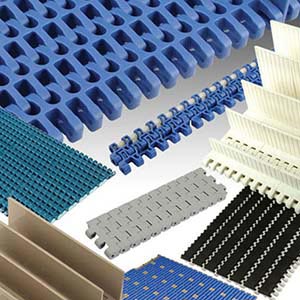
What Are Modular Conveyor Belts?
A modular conveyor belt is built from a series of plastic modules connected by transverse hinge pins, forming an endless belt with no glued joint at the ends. Unlike other belts, modules snap together and apart on site without special tools — a damaged section is replaced locally instead of removing the entire belt. We supply uni-chains and Movex modular belts spanning pitches from 12.7 mm to 63.5 mm and tensile strengths from 2,000 to 100,000 N/m, in straight-running or side-flexing construction for belts that need to turn corners.
The open lattice structure of most modules provides good drainage and airflow, while the smooth surface minimizes product contact — an advantage in food handling where easy cleaning and hygienic contact matter.
Where inclined conveying is required, the belt can be fitted with modules featuring transverse or side profiles to increase throughput.
Nibora Ltd. supplies modular belts to order.
For What Purpose / Who Are They Suitable For?
Modular belts are used wherever an impact-resistant, easy-to-clean, field-repairable conveying surface is required — from food processing lines to heavy-duty industrial conveyors.
| Application | Recommended Series | Key Feature |
|---|---|---|
| Bakery — cooling and freezing lines | uni M-PNB M1 | Pinless design, maximum drainage and airflow, 40% open area |
| Poultry and meat processing | uni M-QNB / M-PNB M1 | Impact-resistant surface, easy to clean, metal-detectable versions |
| Seafood — grading and weighing lines | uni M-QNB | Bi-directional belt, rounded bottom surface for smooth high-speed transfer |
| Beverage and canning — palletizing, accumulation tables | uni QNB / CPB | High tensile strength, impact resistance from cans and bottles |
| Paper, packaging and corrugated lines | uni QNB | Rubber top surface, reduced slippage |
| Automotive and general industry — heavy loads | uni XLB / L-SNB | Maximum tensile strength up to 100,000 N/m, large pitch for long centre distances |
| Curves and change of conveying direction | uni Flex SNB / Flex ONE | Side-flexing construction |
Series Overview
The uni-chains catalog spans over 18 standard series; below is a representative selection covering the full range from light-duty to heavy-duty use.
| Series | Pitch (mm) | Running Type | Tensile Strength N/m (lbf/ft) |
|---|---|---|---|
| uni M-PNB M1 Snap Link | 12.7 | Straight | 2,000 (137) |
| uni M-QNB | 12.7 | Straight | 19,000 (1,302) |
| uni S-MPB Single Link | 25.4 | Straight | 23,500 (1,610) |
| uni QNB | 25.4 | Straight | 35,000 (2,398) |
| uni Light | 19.05 | Straight | 10,250 (702) |
| uni Flex SNB | 25.4 | Side flexing | 30,000 (2,055) |
| uni SSB | 38.1 | Straight | 36,000 (2,467) |
| uni MPB | 50.8 | Straight | 27,500 (1,884) |
| uni X-MPB | 63.5 | Straight | 37,500 (2,570) |
| uni XLB | 63.5 | Straight | 100,000 (6,900) |
Material Selection
Material choice determines operating temperature, chemical resistance and food-contact suitability. Below are the most common material grades; specialized variants (static-dissipative, metal-detectable, flame-retardant, glass-reinforced) are available on request.
| Material | Temperature Range | Load Index (vs. POM) | FDA |
|---|---|---|---|
| POM — Polyoxymethylene | –40 to +90°C | 100% | Yes |
| PP — Polypropylene | +1 to +104°C | 100% | Yes |
| PE — Polyethylene | –50 to +80°C | 100% | Yes |
| PVDF — Polyvinylidenfluoride | –40 to +100°C | 100% | Yes |
| PA6 — Polyamide | –40 to +120°C | 100% | Yes |
| PA6.6 — Polyamide | –40 to +140°C | 100% | Yes |
| GR — Glass Reinforced Polyester | –40 to +125°C | 70% | – |
| FR — Flame Retardant Polyamide | +1 to +104°C | 90% | – |
* FDA "Yes" indicates a standard food-contact-suitable grade; specialized conductive, metal-detectable and flame-retardant variants are not FDA certified.
UNIBELT Catalogue
Download PDF ↓FAQ — Modular Conveyor Belts
What is a modular conveyor belt and how does it differ from a rubber belt?
A modular belt consists of snap-together plastic modules connected by transverse hinges — no glued joint. A damaged section can be replaced locally on site, while a rubber belt requires full replacement or professional repair.
How do I choose the right material (POM/PP/PE/PVDF/PA)?
POM is the standard choice for most applications — good strength and wear resistance. PP is preferred at higher temperatures and with aggressive chemicals. PE suits wet, cold environments. PVDF and PA withstand higher temperatures than POM. Contact Nibora for a recommendation for your specific conditions.
Which belts are suitable for the food industry?
Standard POM, PP, PE, PVDF and PA grades are food-contact approved (FDA). For specific requirements (metal detection, static dissipation), specialized material variants are available.
What is the difference between straight-running and side-flexing belts?
Straight-running series travel only in a straight line between two shafts. Side-flexing series, such as uni Flex SNB and Flex ONE, can travel around horizontal curves — preferred for conveyors that change direction.
How is the required tensile strength determined?
Tensile strength requirements depend on conveyor length, load and friction. Longer conveyors and heavier loads require a higher-strength series (e.g. uni XLB — 100,000 N/m) instead of a light-duty series like uni M-PNB M1 (2,000 N/m).
How are modular belts repaired when damaged?
A damaged section is removed by withdrawing the relevant hinge rod and replaced with new modules on site — without removing the whole belt from the conveyor. This is a key advantage over endless belts with glued joints.