
Main Types of Anti-Vibration Elements
Anti-vibration elements are divided into several main types by operating principle. Choosing the right type is just as important as choosing the right size.
Rubber compression elements — work under compression load. The rubber deforms and absorbs vibrations. Simple, inexpensive, suitable for static loads.
Rubber shear elements — work under lateral load. Lower natural frequency than compression elements at equal stiffness.
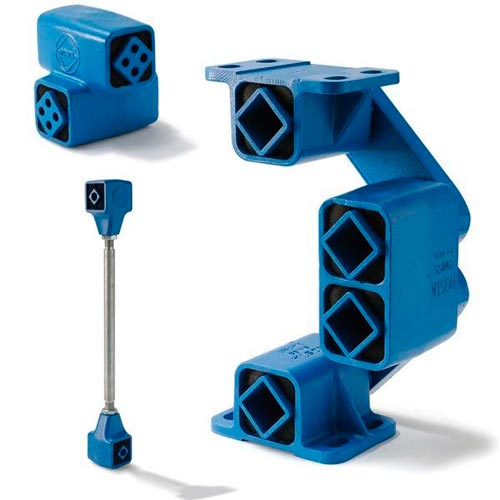
Rubber torsion elements (ROSTA type) — inserts work in torsion as the arm rotates. Provide the lowest natural frequency, absorb vibrations and shock loads simultaneously. Single bolt mounting, 360 degree positioning.
Metal springs — high load capacity, but transmit vibrations directly without absorption. Typical isolation degree 80-90%.
Pneumatic air springs — very low natural frequency, adjustable. Require maintaining air pressure and additional infrastructure.
Two Sub-Categories within ROSTA
ROSTA elements in this product line cover two fundamentally different applications:
Free oscillating systems (AB, AB-HD, AB-D, ABI, HS) — for vibrating screens and sifters where the machine vibrates freely under unbalanced motors. Elements isolate the machine from the building structure.
Guided systems (AU, AS-P, AS-C, AD-P, AD-C, AR, ST, DO-A) — for crank-shaft driven shaker conveyors. AU/AS/AD rocker arms precisely guide the trough movement, while ST drive heads and DO-A accumulators transmit and regulate the force.
How do ROSTA oscillating mountings work?
ROSTA oscillating mountings are rubber-metal supports based on the rubber torsion spring principle. Four natural rubber inserts at 45° inside a metal housing provide a low natural frequency (2–4.5 Hz) and 92–99% vibration isolation at operating frequencies of 700–3000 rpm.
The elements absorb shock loads at start-up and shut-down — a critical moment for standard metal springs. ROSTA dissipates this energy within seconds and stops the machine smoothly.
Who are they designed for?
- Vibrating machine manufacturers — screens, shakers, feeders, fluid beds
- Food and pharmaceutical industry — ABI series (stainless steel AISI 304)
- Mining and construction industry — AB and AB-HD for gravel and mineral screens
- Grain processing and flour milling — AK and AV for gyratory sifters (plan sifters)
- Chemical and woodworking industry — AB-D for spiral and two-mass conveyors
- Any industry with vibrating equipment mounted in a building or steel structure
ROSTA Anti-Vibration Elements Catalogue
Download PDF ↓Frequently Asked Questions
What is the difference between AB, AB-HD, AB-D and ABI?
See the table below with key characteristics of each series:
| Series | Load range (N) | Natural freq. (Hz) | Sizes | Application |
|---|---|---|---|---|
| AB | 50 – 20,000 | 2.1 – 4.3 | 9 | Universal — circular and linear screens |
| AB-HD | 500 – 14,000 | 2.4 – 4.8 | 6 | Heavy Duty — impact loading and production peaks |
| AB-D | 500 – 16,000 | 3.5 – 6.1 | 7 | Compact — counterframe two-mass systems |
| ABI | 70 – 6,800 | 2.2 – 4.0 | 6 | Stainless steel — food and pharmaceutical industry |
| HS | 500 – 14,000 | 3.2 – 4.2 | 5 | Hanging systems — discharge chutes (tensile load) |
What degree of vibration isolation is achieved?
At 960 rpm and 2.7 Hz natural frequency — 97%. At 1440 rpm — 98–99%. Below 85% is not recommended (machine runs too close to resonance).
What is cold flow and how does it affect installation?
Final deflection after full compensation (~1 year) = catalogue value × 1.09. Must be considered when setting the mounting axis and machine horizontality.
What are the three main shaker system types and which elements are used?
See the table below with the three systems and their parameters:
| System | Acceleration (g) | Speed (m/min) | Length (m) | ROSTA elements |
|---|---|---|---|---|
| One mass — brute force | 1.1 – 1.7 | 6 – 15 | up to 12–15 | AU, AS-P, AS-C, AR + ST |
| One mass — with accumulators | 1.1 – 2.2 | 6 – 22 | up to 20 | AU, AS-P, AS-C, AR + ST + DO-A |
| Two mass — fast runner | 1.5 – 5.0 | 10 – 45 | up to 20 | AD-P, AD-C, AR + ST + DO-A |
What is the maximum load capacity of AU rocker arms?
Depends on acceleration factor K. See the full data table:
| Type | K<2 (N) | K=2 (N) | K=3 (N) | K=4 (N) | Max. rpm (α±5°) |
|---|---|---|---|---|---|
| AU 15 | 100 | 75 | 60 | 50 | 640 |
| AU 18 | 200 | 150 | 120 | 100 | 600 |
| AU 27 | 400 | 300 | 240 | 200 | 560 |
| AU 38 | 800 | 600 | 500 | 400 | 530 |
| AU 45 | 1 600 | 1 200 | 1 000 | 800 | 500 |
| AU 50 | 2 500 | 1 800 | 1 500 | 1 200 | 470 |
| AU 60 | 5 000 | 3 600 | 3 000 | 2 400 | 440 |
How is the number of rocker arms calculated for a shaker conveyor?
Formula: z = (L / Lmax + 1) × 2, where Lmax = max. distance between rockers (typically 1.5 m). For trough width > 1.5 m, add a third central row.
What are DO-A spring accumulators?
1 accumulator = always 2 pcs. DO-A elements. System is a natural frequency shaker when resonant factor is >= 0.8. See table:
| Type (2 pcs. = 1 accumulator) | Art. No. | Dynamic spring value cs (N/mm) |
|---|---|---|
| DO-A 45x80 | 01 041 013 | 100 |
| DO-A 45x100 | 01 041 014 | 125 |
| DO-A 50x120 | 01 041 016 | 190 |
| DO-A 50x160 | 01 041 019 | 255 |
| DO-A 50x200 | 01 041 017 | 320 |
How are AK universal joints installed for a gyratory sifter?
2 pcs. AK per support column, installed crosswise at 90°. Distance X must be identical for all columns. Max. angle +/-3.5 deg, max. ~380 rpm. See table:
| Type | Hanging (N) | Staying, crank (N) | Staying, free (N) | Weight (kg) |
|---|---|---|---|---|
| AK 15 | 160 | 128 | 80 | 0,4 |
| AK 18 | 300 | 240 | 150 | 0,6 |
| AK 27 | 800 | 640 | 400 | 1,9 |
| AK 38 | 1 600 | 1 280 | 800 | 3,7 |
| AK 45 | 3 000 | 2 400 | 1 500 | 6,7 |
| AK 50 | 5 600 | 4 480 | 2 800 | 11,4 |
| AK 60 | 10 000 | 8 000 | 5 000 | 37,4 |
| AK 80 | 20 000 | 16 000 | 10 000 | 85,4 |
| AK 100-4 | 30 000 | 24 000 | 15 000 | 124 |
| AK 100-5 | 40 000 | 32 000 | 20 000 | 148 |
When is the HS series used and how does it differ from AB?
HS (Hanging Screen) works in tension — unlike AB (compression). For discharge chutes under silos and bunkers. Certified per 2006/42/EG for hanging load capacities (HS 50).
Practical selection example — upright gyratory sifter
Given: m=1600 kg, R=25 mm, X=600 mm, ns=230 rpm, 4 columns. Angle: 2.4 deg. Load: G=3924 N. AK 50 = 4480 N max. Selection: 4 columns x 2 pcs. AK 50 = 8 pcs. AK 50
Technical data — AB series (full table)
| Type | Art. No. | Load (N) | Freq. (Hz) | cd vert. (N/mm) | Weight (kg) |
|---|---|---|---|---|---|
| AB 15 | 07 051 056 | 50 – 160 | 4,3 – 2,8 | 10 | 0,5 |
| AB 18 | 07 051 057 | 120 – 300 | 3,6 – 2,6 | 18 | 1,2 |
| AB 27 | 07 051 058 | 250 – 800 | 3,7 – 2,7 | 40 | 2,2 |
| AB 38 | 07 051 059 | 600 – 1 600 | 3,0 – 2,4 | 60 | 5,1 |
| AB 45 | 07 051 054 | 1 200 – 3 000 | 2,8 – 2,3 | 100 | 11,5 |
| AB 50 | 07 051 061 | 2 500 – 6 000 | 2,4 – 2,1 | 190 | 20,8 |
| AB 50-2 | 07 051 055 | 4 200 – 10 000 | 2,4 – 2,1 | 320 | 32,2 |
| AB 50 TWIN | 07 051 008 | 5 000 – 12 000 | 2,4 – 2,1 | 380 | 35,0 |
| AB 50-2 TWIN | 07 051 009 | 8 400 – 20 000 | 2,4 – 2,1 | 640 | 54,0 |