
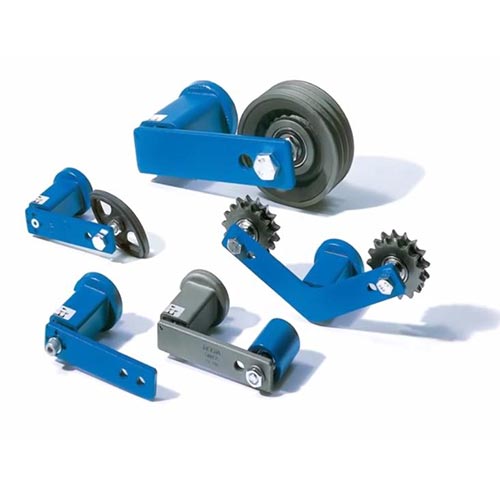
Types of tensioners — operating principles
There are five main principles for automatic tensioning of chain and belt drives in industry:
Metal spring tensioners — a linear or torsion metal spring creates a constant force. Simple and reliable, but transmit vibrations directly into the drive.
Rubber torsion spring tensioners — a rotating arm with rubber elastomeric inserts. Absorb vibrations, operate maintenance-free and can be mounted at any angle. ROSTA tensioners belong to this category.
Hydraulic tensioners — an oil-pressure cylinder provides very consistent force. Require a hydraulic system; typical for automotive engine timing chains.
Gravity / weight tensioners — a weighted arm presses on the chain or belt. Simple and inexpensive, but only work in a fixed orientation.
Manual (bolt-type) tensioners — fixed position, tightened by hand. Require periodic maintenance. The most economical solution for slow-wearing applications.
What makes ROSTA different?
ROSTA belongs to the rubber torsion spring tensioner category — a sub-category that differs fundamentally from classical metal springs in three key characteristics:
1. Vibration absorption instead of transmission
A metal spring transmits vibrations directly into the frame and drive. ROSTA's rubber inserts dampen them through internal molecular friction — the result is quieter and smoother operation of the entire drive.
2. Zero maintenance
Metal springs corrode, require lubrication and lose elasticity over time. ROSTA's rubber inserts do not corrode, need no lubrication and retain their characteristics for the entire service life of the device.
3. 360° mounting with a single bolt
Unlike hydraulic or gravity tensioners, ROSTA can be mounted at any angle — horizontal, vertical or inclined. Only one central bolt and one hole in the structure are required. Pre-tension is set precisely using a torsion angle scale.
How do ROSTA tensioners work?
ROSTA tensioners are based on the rubber torsion spring principle. The elastomeric inserts made of high-elastic natural rubber with good shape memory provide a constant tensioning force as the arm rotates — with no mechanical adjustment, no stressed springs, and no wearing slides.
The device simultaneously performs three functions:
Automatic tensioning over a very wide compensation range — roller chains elongate by 1 to 3% of total length due to wear; without compensation the slack side oscillates and the so-called polygon effect occurs
- Vibration damping — through internal molecular friction in the rubber inserts
- Noise reduction from the polygon effect of the chain drive
Installation requires only a single central bolt — only one fixing hole is needed in the machine structure. On smooth surfaces no additional securing is required.
Who are they designed for?
ROSTA tensioners are the choice of engineers, designers and machine manufacturers in the following industries:
Food & chemical industry — SEI series in stainless steel (AISI 304)
Construction and agricultural machinery — SE-G series with zinc-plated parts and oil-resistant inserts for outdoor use
- Engine equipment and diesel engines — SE-W series with heat-resistant inserts up to +120°C
- Woodworking, paper and mining industry — standard SE series
- All chain and belt drives where elongation over time is unavoidable
ROSTA Tensioners Catalogue
Download PDF ↓Frequently Asked Questions
What is the difference between the SE, SE-G and SE-W series?
SE (standard) — natural rubber inserts, painted steel parts. Operating temperature: –40°C to +80°C. Universal application.
SE-G — zinc-plated steel parts and oil-resistant synthetic inserts. For outdoor use and oily environments (gearboxes, crankcases).
SE-W — heat-resistant elastomeric inserts for temperatures from +80°C to +120°C. Important: tensioning force is 40% lower than standard SE under equal conditions.
What is the maximum tensioning force for the SE series?
Standard SE series range at 'normal' position and 30° pre-tension angle:
| Size | Max. force (N) | Max. stroke s (mm) | Torque MA (Nm) | Weight (kg) |
|---|---|---|---|---|
| SE 11 | 80 | 40 | 10 | 0.20 |
| SE 15 | 135 | 50 | 25 | 0.40 |
| SE 18 | 350 | 50 | 49 | 0.60 |
| SE 27 | 800 | 65 | 86 | 1.70 |
| SE 38 | 1,500 | 87.5 | 210 | 3.55 |
| SE 45 | 2,600 | 112.5 | 410 | 6.40 |
| SE 50 | 4,200 | 125 | 750 | 9.00 |
In the 'hard' position the force is approximately 25% higher.
What is the SEI series and when is it used?
SEI is a stainless steel series (DIN 1.4301 / AISI 304) designed for the food industry and chemical process technology. Available in four sizes:
| Type | Max. force (N) | Max. stroke (mm) | Torque (Nm) | Weight (kg) |
|---|---|---|---|---|
| SEI 15 | 150 | 50.0 | 25 | 0.35 |
| SEI 18 | 400 | 50.0 | 49 | 0.70 |
| SEI 27 | 860 | 65.0 | 86 | 1.92 |
| SEI 40 | 1,500 | 87.5 | 210 | 4.29 |
What is ROSTA KSE and when is it chosen instead of a standard SE?
KSE is a ready-to-use complete V-belt tensioner — the SE element (sizes 18, 27 or 38) is fitted with a factory-installed steel axle and a cast iron V-belt pulley with quality ball bearings. No additional pulley assembly is required by the customer.
| Type | Grooves | Max. speed (rpm) | Max. force (N) | Max. stroke (mm) |
|---|---|---|---|---|
| KSE 18-SPZ | 1 | 10,000 | 350 | 50.5 |
| KSE 18-SPZ | 2 | 10,000 | 350 | 50.5 |
| KSE 18-SPZ | 3 | 10,000 | 350 | 50.5 |
| KSE 27-SPA | 1 | 7,400 | 800 | 65.5 |
| KSE 27-SPA | 2 | 7,400 | 800 | 65.5 |
| KSE 27-SPA | 3 | 7,400 | 800 | 65.5 |
| KSE 27-SPB | 1 | 5,300 | 800 | 65.5 |
| KSE 27-SPB | 2 | 5,300 | 800 | 65.5 |
| KSE 38-SPB | 3 | 4,000 | 1,500 | 87.5 |
How do you select the correct tensioner size for a V-belt drive?
Follow five steps:
Determine the test force for the relevant belt section (e.g. SPB at pulley Ø 160–224 mm = 50 N).
Multiply by the number of belts (e.g. 3 belts × 50 N = 150 N).
Add 100% reserve for start-up (150 N × 2 = 300 N).
Select a tensioner providing this force at 20° pre-tension (e.g. SE 27 = 380 N at 20°).
- Set at 25° pre-tension angle to compensate for initial elongation.
- What are the tensile control forces for standard V-belts?
Control forces (at ideal pre-tension — deflection of 16 mm per 1000 mm centre distance):
| Belt type | Ø Small pulley (mm) | Control force (N) |
|---|---|---|
| SPZ (10 N) | 56 – 95 | 12 – 15 |
| SPZ (10 N) | 100 – 140 | 17 – 20 |
| SPA (13 N) | 100 – 132 | 25 – 27 |
| SPA (13 N) | 140 – 200 | 30 – 35 |
| SPB (16 N) | 160 – 224 | 45 – 50 |
| SPB (16 N) | 236 – 315 | 60 – 65 |
| SPC (22 N) | 224 – 355 | 80 – 90 |
| SPC (22 N) | 375 – 560 | 100 – 120 |
| 13×8 (A) | 80 – 140 | 12 – 15 |
| 17×11 (B) | 125 – 200 | 25 – 30 |
| 22×14 (C) | 200 – 400 | 55 – 60 |
| 32×20 (D) | 355 – 600 | 90 – 105 |
Which SE tensioner size matches which chain according to DIN 8187 / ISO R606?
Chain-to-tensioner size compatibility table:
| Chain DIN 8187 | Pitch × width | Sprocket wheel type N | Chain rider type P | SE size |
|---|---|---|---|---|
| 06 B-1/2 | 3/8" × 7/32" | 3/8"-10 S / 3/8"-10 D | 3/8"-8 S / 3/8"-8 D | 11 / 15 / 18 |
| 06 B-3 | 3/8" × 7/32" | 3/8"-10 T | — | 18 |
| 08 B-1/2 | 1/2" × 5/16" | 1/2"-10 S / 1/2"-10 D | 1/2"-10 S/D | 15 / 18 |
| 08 B-3 | 1/2" × 5/16" | 1/2"-12 T | — | 27 |
| 10 B-1 | 5/8" × 3/8" | 5/8"-10 S / 5/8"-12 S | 5/8"-10 S | 18 / 27 |
| 10 B-2 | 5/8" × 3/8" | 5/8"-10 D / 5/8"-12 D | 5/8"-10 D | 18 / 27 |
| 10 B-3 | 5/8" × 3/8" | 5/8"-12 T / 5/8"-20 T | — | 27 / 38 |
| 12 B-1/2 | 3/4" × 7/16" | 3/4"-12 S/D / 3/4"-20 S/D | 3/4"-12 S/D | 27 / 38 |
| 12 B-3 | 3/4" × 7/16" | 3/4"-20 T | — | 38 |
| 16 B-1/2 | 1" × 17 mm | 1"-20 S / 1"-20 D | — | 38 |
| 16 B-3 | 1" × 17 mm | 1"-20 T | — | 45 |
| 20 B-1/2/3 | 1¼" × 3/4" | 1¼"-20 S/D/T | — | 45 / 50 |
| 24 B-1/2/3 | 1½" × 1" | 1½"-20 S/D/T | — | 45 / 50 |
| 32 B-1/2/3 | 2" × 1¼" | — | — | 50 |
How many bolts are needed for installation and when is additional securing required?
Only one central bolt. Only one fixing hole is required in the machine structure. On smooth, clean and torsionally rigid surfaces, the frictional resistance between the tensioner housing and the machine element is a multiple of the maximum tensioning torque at 30°. Additional securing is only recommended on rough or heavily corroded surfaces — using a locking pin through the positioning notch.
What accessories are combined with SE series tensioners?
Sprocket wheel set type N — for chain drives on self-lubricating ball bearing 2Z. Simplex (S), Duplex (D), Triplex (T) for chains 3/8" to 1½" per DIN 8187.
Chain rider set type P — made of friction-resistant industrial plastic. Low-noise and low-cost alternative. Max. chain speed: 1.5 m/s.
Tensioning roller type R — industrial plastic with two self-lubricating ball bearings 2Z, for belt drives.
Practical selection example — chain drive
Given: Chain drive with 1"-Duplex roller chain 16 B-2 per DIN 8187. Front mounting on hollow steel structure. Normal temperature range up to +80°C.
Selected:
Tensioner: ROSTA SE-F 38, Art. No. 06 061 005 (front mounting, up to 1,500 N)
Sprocket wheel: N 1"-20 D (Duplex, 13 teeth), Art. No. 06 520 006