
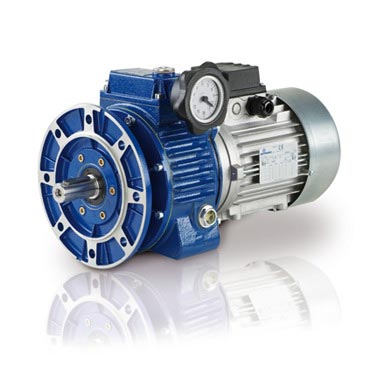
What is a motovariator?
A motovariator is a mechanical device for stepless (continuous) speed variation of the output shaft without changing the input motor speed. The operating principle is based on a system of planet discs pressed together by Belleville springs. Turning the control handwheel shifts the working radius of the planet discs, thereby changing the transmission ratio continuously.
Unlike frequency inverters (VFDs), a motovariator is a purely mechanical solution — no electronics, no control circuitry, no losses from electrical energy conversion. Speed adjustment is performed directly on the running drive by turning the handwheel or via an electric servo-actuator.
Series TXF/S: compact motovariators with direct output or flange. Series VH/VHA: motovariators with integrated helical gear reducer (aluminium or cast-iron housing). Series TXF/S+NMRV: motovariator combined with NMRV worm gear reducer — very low output speeds achieved.

Applications — what is it suitable for?
Motovario motovariators are designed for drives requiring stepless speed adjustment during operation — without stopping the machine. The device is ideal when:
- Electronic control is undesirable or impractical due to environmental conditions (dust, moisture, temperature extremes, aggressive chemicals).
- Speed adjustment must be performed under load while the motor is running.
- High mechanical reliability with minimal electronic maintenance is required.
Typical load categories — A (uniform): fans, assembly lines, light conveyors, fillers; B (moderate shocks): winches, winding devices, concrete mixers, packaging machines, gear pumps; C (heavy shocks): mixers for heavy materials, presses, centrifuges, shredders, hammer mills, vibrators.
Series comparison
| Parameter | TXF002-010 | S003-100 | VH/VHA | TXF+NMRV | SD (differential) |
|---|---|---|---|---|---|
| Power range (kW) | 0.15 – 2.2 | 0.15 – 9.2 | 0.15 – 9.2 | 0.15 – 2.2 | up to 9.2 |
| Output speed range | 170 – 2000 rpm | 120 – 2000 rpm | 0.8 – 530 rpm | up to 100 rpm | 0 to max |
| Speed ratio 1:x | ≈ 1:5 | ≈ 1:5 | ≈ 1:5 + reducer | ≈ 1:5 + worm | 0 to max |
| Max output torque | up to 144 Nm | up to 144 Nm | up to 2200 Nm | up to 18,000 Nm | up to 144 Nm |
| Housing material | Aluminium | Aluminium | Alum. / Cast iron | Alum. + NMRV | Aluminium |
| ATEX available | On request | On request | On request | On request | On request |
Mounting positions
All series support standard mounting positions: B3 (horizontal — standard delivery), B5, B6, B7, B8 (horizontal variants), V1, V3, V5, V6 (vertical positions). The mounting position must be specified at ordering as oil fill quantities differ. For positions not listed in the catalogue, consult technical service.
Admissible radial loads — output shaft (Fr2 max, N)
| Series / Size | 030 | 040 | 050 | 063 | 075 | 090 | 105 | 110–130 |
|---|---|---|---|---|---|---|---|---|
| NMRV output Fr2 (N) | 1830 | 3490 | 4840 | 6270 | 7380 | 8180 | 12000 | 13500 |
| H (1-stage) Fr2 (N) | — | 1000 | 2500 | 3700 | 4000 | 5000 | 6000 | — |
| SF output Fr2 (N) | 760 | 1120 | 1910 | 2290 | 4540 | 4540 | 5890 | — |
Lubrication specifications
| Series | Oil type | ISO VG grade | Service interval |
|---|---|---|---|
| TXF 002–010 | Mineral (ATF Dexron) | ISO VG 32 | Lifetime — no maintenance |
| S 003–100 | Mineral | ISO VG 220 | Change every ~10,000 h (5,000 h for variator) |
| NMRV 030–105 | Synthetic (AGIP Telium VSF) | ISO VG 320 | Lifetime — no maintenance |
| NMRV 110–130 | Mineral (AGIP Blasia 460) | ISO VG 460 | Change as required |
| H / VH series | Mineral | ISO VG 220 | Depends on mounting position |
Motovario catalogue
Download PDF ↓FAQ — Frequently Asked Questions (English)
What is the difference between a motovariator and a variable frequency drive (VFD/inverter)?
A motovariator is a fully mechanical device — it adjusts speed by changing the working radius of planet discs, with no electronics whatsoever. A VFD adjusts the frequency of the current to the motor and requires control electronics, making it sensitive to moisture, dust, and heat. Advantages of the motovariator: simpler maintenance, suitability for harsh environments, no EMC interference, longer service life under correct conditions. A VFD is preferable when precise digital control and remote monitoring are required.
Can a motovariator reach zero output speed?
A standard motovariator CANNOT reach zero output speed — minimum output speed is approximately 1/5 of maximum. To achieve zero-to-maximum speed range, an SD version with epicyclic differential is required. Near zero speed, the torque curve drops to zero and performance may become irregular — application torque must be carefully verified in this range.
What is the speed variation ratio of a motovariator?
The standard variation ratio is approximately 1:5 (e.g. max 1000 rpm : min 190 rpm). When combined with a helical reducer (VH series), output speeds as low as 0.8 rpm are achievable. Combined with an NMRV worm reducer (TXF+NMRV series), output torques up to 18,000 Nm can be reached.
Must speed adjustment be done while the motor is running?
Yes — this is a mandatory requirement for all Motovario motovariators. Speed adjustment via the handwheel MUST be performed only with the motor running. Adjusting a stationary variator can cause permanent damage.
What ambient temperature range is supported?
Standard operating range: -5°C to +40°C. Below -5°C: special seals required and motor must be rated for low temperature. Below -15°C: cast-iron housings (H/VH series) risk brittleness under impact loads. Above +40°C or below -30°C: mandatory consultation with technical service.
What is the maximum number of starts per minute?
Approximately 5–10 starts per minute depending on application type. For higher starting frequencies, contact Nibora technical service for a specific assessment.
How do I calculate the admissible radial load on the output shaft?
Formula: Fre = (2000 × M2 / D) × fz, where M2 = output torque in Nm, D = diameter of the transmission element mounted on the shaft (mm), fz = correction factor: 1.1 for gear pinion, 1.4 for chain wheel, 1.7 for V-pulley, 2.5 for flat pulley. The permissible value Fr2 is given in the performance tables for each size.
What is the service interval for oil changes?
Variator unit: oil change after approximately 5,000 operating hours. Gear reducer (H/VH series): after approximately 10,000 operating hours. Units supplied without oil plugs (NMRV 030–105, small TXF units) are lifetime lubricated and require no oil changes. Intervals depend on operating conditions and environment.