
What are cylindrical spur gears
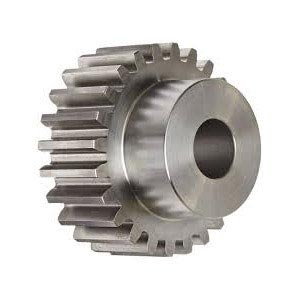
Spur gears transmit power between two parallel shafts (or between a gear and a rack) through direct tooth engagement, without slippage. The transmitted speed depends on the number of teeth of each gear in mesh — a larger number of teeth on the driven gear reduces speed and increases torque.
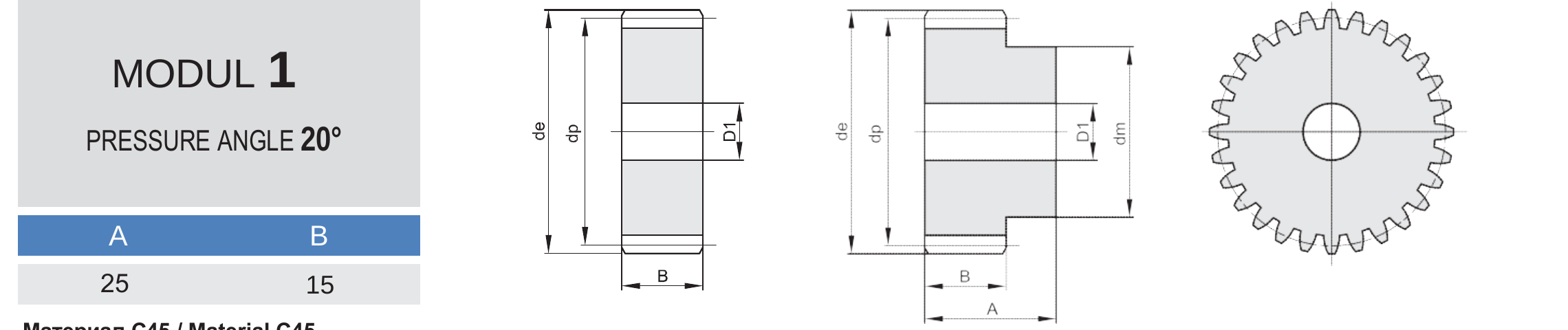
Nibora Ltd. keeps cylindrical spur gears in stock made from C45 material, with a 20° pressure angle, in 8 standard modules — from module 1 to module 6. Each gear is designated by its number of teeth Z, which together with the module determines the exact pitch diameter (dp = module x Z).
Full size table by module and number of teeth
Select a module and/or number of teeth (Z) to find the exact size. de is the outer diameter, dp the pitch diameter, dm and D1 the hub and bore dimensions on the larger gears.
Specifications
Download PDF ↓Full size table — cylindrical spur gears
| Module | Z | de (mm) | dp (mm) | dm (mm) | D1 (mm) | kg |
|---|
No matching gear — contact us for a custom configuration.
Frequently asked questions
How do I choose a module?
The module determines the tooth size and must match the module of the mating gear or rack in the drive — both parts in a mesh must share the same module. A larger module means a bigger tooth and higher load capacity at the same number of teeth.
What does D1 mean in the table?
D1 is the bore diameter (for shaft mounting), and dm is the hub diameter around the bore. For the smallest tooth counts of each module, the bore/hub are not provided in the standard version (marked with a dash in the table).
What is the difference between spur, bevel gears and racks?
Spur gears transmit rotation between parallel shafts. Bevel gears (see the corresponding section on the site) transmit rotation between shafts intersecting at an angle (usually 90°). Racks convert the rotary motion of a gear into linear motion and vice versa.
What is the price of the gears?
Contact Nibora Ltd. for a quote based on the selected module and number of teeth.